
.svg)


Compare electricity providers in Melbourne


Compare electricity providers in Melbourne




Written by
Rachel Gregg
Edited by
Ellie Garran
Reviewed by
Julia PaszkaSee our range of Energy Providers






iSelect does not compare all providers in the market or all plans offered by our partners in your area. Not all plans or special offers are available to all customers and some may only be available over the phone or on the website. Learn more.
Why should I switch electricity providers in Melbourne?
Switching electricity providers in Melbourne can help you find a plan that better matches your usage habits, budget and preferences, while potentially saving you some money. By comparing your current plan against what’s available in your area, you can see where your energy plan might differ from others in pricing, tariffs and benefits like solar feed-in tariffs (as long as you have a smart meter).
Switching electricity providers may help you lock in lower rates, extra discounts, or simply find a better fit for your lifestyle. This depends on your usage, location and the plans available to your postcode. Regularly comparing electricity plans can help you stay on your current plan or find a new one that better works for your energy needs.
How does the electricity market work in Melbourne?
Melbourne’s electricity market has been privatised since 2002 and deregulated since 2009, which means there’s plenty of competition among electricity providers’ plan prices and lower prices available. Melbourne is a part of the National Electricity Market (NEM), which connects the eastern and southern states’ power systems.
Electricity providers in Melbourne are able to compete with others in the state, but they can’t create their own prices as they go. The Victorian Default Offer acts as a default price for standing offers, which acts as a benchmark to keep market plans in check. This caps the maximum price retailers can set and makes it easier to see how plans compare to this regulated price.
It’s easy to get a better deal with iSelect
Switching electricity providers is so easy, you shouldn’t even break a sweat.

Tell us about yourself
Share a few details about your household and the type of electricity plan you’re after.

Explore your options
Search and filter a range of electricity plans based on what’s important to you.

Pick your preferred plan
Once you’ve found an electricity plan you like, you can close the deal online or speak with one of our electricity comparison experts over the phone.

Get connected, no worries
Let us know which plan you’d like to move to, and we can handle the switch, saving you time and hassle.
Compare electricity providers in Melbourne
See if you can find a better deal for your home
Your electricity, simplified
Easily compare, select and potentially save from our range of plans and providers.

More than 1.7 million online energy comparisons made
Since 2018, iSelect has helped everyday Aussies compare energy plans online more than 1.7 million times.

We know energy
If you’re tangled up in tariffs or trying to figure out what plans you’re eligible for, we can help you cut through the jargon.

We tell it how it is
Sometimes a good deal just can’t be beat. If we can’t offer you a better value plan, we’ll be upfront with you.

Compare how you want to
Our Australian-based energy comparison experts are only a call away, or you can compare online. It’s up to you!
While our service to you is provided free of charge, we know there’s no such thing as a free lunch. Learn more about how we make money.
How much does electricity cost in Melbourne?
The Victorian Default Offer for 2026–27 has a benchmark price of $1,591 for residents with an annual usage of 4,000 kilowatt-hours (kWh), which is about 5% less than the previous year, according to the Essential Services Commission. But electricity costs in Melbourne aren’t one-size-fits-all. Prices depend on things like your location, provider and plan.
Looking at this broken down into cents per kilowatt hour (kWh), market offers in Victoria charge an average of 39 cents per kWh, while standing offers average a touch higher at 42 cents per kWh. Homes within AusNet’s distribution area are charged 44 cents per kWh on a market plan and 47 cents per kWh on a standing offer, coming in as the highest price across Victoria. On the other hand, customers within United Energy’s jurisdiction are seeing market offers priced at 37 cents per kWh and standing offers at 40 cents per kWh, according to the Australian Energy Regulator.
Let’s take a closer look at the average cost per kWh across Victoria’s energy distributors. This can help you see how your plan stacks up and where you might save.
| Market offer | Standing offer | |
|---|---|---|
| Citipower | 37 cents | 40 cents |
| AusNet | 44 cents | 47 cents |
| Jemena | 38 cents | 42 cents |
| Powercor Australia | 40 cents | 42 cents |
| United Energy | 37 cents | 40 cents |
Note: These figures reflect indicative median and standing offer prices in Victoria 2026-27 set by the Essential Services Commission. Actual costs may vary depending on household location, size and usage.
How do I choose an electricity provider in Melbourne?
To pick an electricity provider, you’ll need to understand your energy usage to choose a plan that matches it, know the contract type you’re after and check for any discounts, concessions or GreenPower options available to you. Looking at these elements will help you make sure that the Melbourne energy retailer you choose is a good fit for your needs and budget.

Understand your usage
Understanding when and how you use your energy can help you choose a plan that better suits your household’s habits. If you work from home and run appliances like the washing machine and heater during the day, you could be suited to a different rate structure from someone who’s out all day and uses the bulk of their power at night. Knowing your habits will guide you to the right plan and help you make sure that it works more efficiently for you.

Contract types
Looking beyond the advertised price of an energy plan can help you better understand its value to your home. Checking whether your contract has fixed energy rates or variable rates, along with any conditional discounts and fees (like disconnection or early exit) can help you avoid any surprises down the track and choose a plan that suits your needs in every way.
If you’re after a bit more certainty, fixed energy rates could be the answer or if you want to be able to jump from one plan to the other a variable plan could work, just make sure to choose a contract type that matches your needs.

Discounts and concessions
Discounts and rebates can help lower the price of your electricity costs, but you’ll need to make sure you’re eligible for these before signing up. Not all discounts are guaranteed; you might need to complete a condition before being eligible (hence the name conditional discounts). You should do the same for any concession as well. Checking whether you can get these discounts on your electricity can help you decide which plans are worth signing up for.

Green energy options
If sustainability is important to you, choosing a provider that supports renewable energy or has GreenPower options available will be an important factor when choosing a provider. You could find that some electricity plans come with carbon offset features, solar soak periods (free electricity in the middle of the day) or solar feed-in tariffs, which can help make sure your home and provider align with your environmental preferences.
 Helpful tip

These days, plenty of Melbourne’s energy providers offer carbon-neutral plans. It’s a simple way to balance your household emissions with providers offsetting them on your behalf through reforestation projects or technology-based credits.
Julia Paszka
General Manager – Utilities & Credit Cards
Which electricity distributors operate in Melbourne?
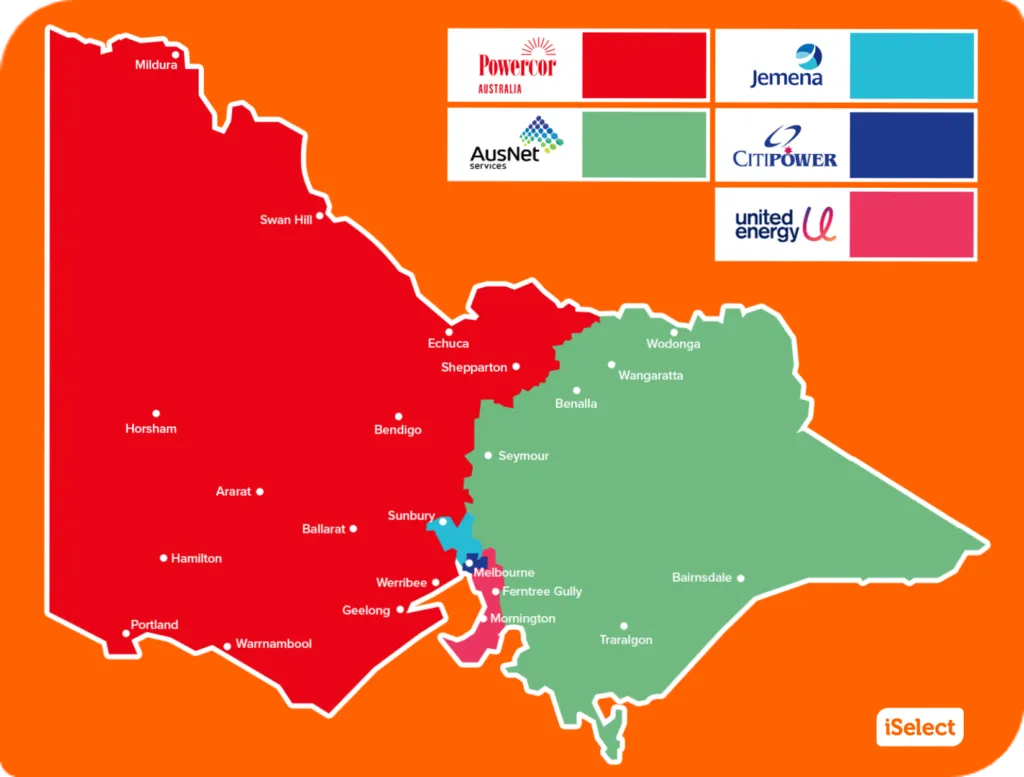
Powercor, AusNet, Jemena, United Energy and CitiPower are the 5 distributors that power Melbourne and wider Victoria. Your electricity distributor owns the poles, wires and infrastructure that keep your home connected to the grid, while electricity providers buy this energy and sell it to you. Unlike providers, you don’t get to pick your distributor; it’s assigned based on where you live.
In your day-to-day, knowing your distributor won’t make much of a difference. But it can come into play when looking at electricity plans, particularly if you want to go for the Victorian Default Offer (VDO), which determines your pricing based on your location. At its heart, the VDO isn’t the cheapest electricity plan around, but the Essential Services Commission maintains it as a safeguard, making sure you aren’t overpaying for your home’s electricity usage.
Frequently asked questions
Which electricity providers operate in Melbourne?
EnergyAustralia, Lumo Energy, OriginEnergy and 1st Energy are all electricity operators available within Melbourne. The exact range of electricity retailers available to you will depend on your location, setup, tariff types and your general usage.
Some of the electricity brands in Melbourne compared by iSelect include the following.
However, there are also other providers that operate in Melbourne, including the following:
- 1st Energy
- Alinta Energy
- Amber Electric
- Arcline by RACV – Energy
- Blue NRG
- CovaU
- Diamond Energy
- Dodo
- Electricityinabox
- Energy Locals
- Energy Locals Urban
- Flow Power
- GloBird Energy
- Indigo Power
- Kogan Energy
- Momentum Energy
- MYOB powered by OVO
- Nectr
- Next Business Energy
- OVO Energy
- Pacific Blue
- Perpetual Energy
- Powershop
- Real Utilities
- SmartestEnergy
- Solstice Energy
- Sumo
- Tango Energy
Just remember that iSelect can only help you compare from a selected range of providers.
How is my electricity charged in Melbourne?
Electricity bills are based on 2 main charges: your usage charge and your daily supply charge, which looks at the power used per kilowatt hour and a standard daily charge for being connected to the grid. If you’re on a tariff other than a standard flat rate, then your tariff type can also change the way your usage is charged on your bill. You also need to look at any late fees or discounts that can affect your final bill.
Here are all the charges that can make up your quarterly electricity bill:
- Supply charge: This is the daily cost of keeping your place connected to the electricity grid. It won’t go up or down, no matter how much electricity you use in a day.
- Usage charge: This is where your electricity use comes into play, along with tariffs. This charge will change depending on how much electricity you use in a day and sometimes when you use it.
- Single-rate tariff: This is a flat rate for your usage charge. It can make it easy to figure out what your electricity bill will look like if you know your average daily usage.
- Time-of-use tariff: This usage charge takes into account when you use your electricity. For instance, it might come with a higher usage rates during peak demand times in the evenings, but a lower rate during the middle of the day and options for a solar soak period in the middle of the day.
- Controlled-load tariff: If you have a pool or heated flooring that uses up a lot of your electricity usage, a controlled load puts these appliances on a separate meter to run at cheaper off-peak times.
- Demand tariff: This tariff takes into account your usage as well as the demand you put on the electricity grid, particularly at peak times
- Solar feed-in tariff (FiT): With solar panels, you can put electricity back into the grid and get paid for it, although FiTs are a lot lower than they used to be.
- Late fees: If you’ve paid your bill after the due date and haven’t requested an extension, you could be hit with a late fee on your next bill.
- Discounts: From signing up for a particular plan to paying by direct debit, you might be able to shave a little off your bill. Just make sure to check for conditional discounts, which are only available once you reach eligibility, like paying on time.
What energy concessions or rebates can I get in Melbourne?
The Annual electricity concession, Excess electricity concession, Medically cooling concession and Essential medical equipment payment are available to help lower electricity bills and take some pressure off high bills for residential customers who meet eligibility.
Annual electricity concession
If you’ve got a Health Care Card, Pensioner Concession Card or a Veteran Gold Card, you could be eligible to get 17.5% of your electricity bill back after the first $171.60 of your bill, according to the Victorian State Government.
Excess electricity concession
If your electricity bill is higher than $4,038.82 and you hold a valid concession card, you could be eligible for 17.5% of your bill back, this is an accordance to the Victorian State Government. This is calculated after retailer discounts and solar energy credits have all been applied.
Medical cooling concession
If you’re unable to regulate your body temperature and have high energy bills, you could get a concession between 1 November and 30 April. If you’ve got an eligible condition, like MS or Parkinson’s disease, and you have an eligible concession card, you could get a concession for 17.5% of your electricity usage.
Essential medical equipment payment
If you have higher than average energy costs due to essential medical equipment, you can a one-time payment of $203 per year to help with these rising bills, in accordance with Services Australia.
Get started on comparing energy plans today!
Save time and effort by comparing a range of energy plans with iSelect





iSelect does not compare all energy providers or plans in the market. The availability of plans may change from time to time, depending on who iSelect’s providers are and what plans they make available to iSelect. Not all plans made available from iSelect providers may be compared by iSelect either due to commercial arrangements, area or availability, so not all plans or providers compared by iSelect will be available to all customers. Some plans and special offers are available only from iSelect’s contact centre or website. Energy plans are available only for properties located in eligible areas of Victoria, New South Wales, South East Queensland, South Australia and ACT. Click here to view iSelect’s range of providers.