
.svg)


How Much Do Dentures Cost?
How Much Do Dentures Cost?




Written by
Madeline Pettet
Edited by
Ellie Garran
Reviewed by
Andres GutierrezCompare Health Insurance Policies
Save time and effort by comparing a range of Australia’s health funds with iSelect

What are dentures?

Long story short
Dentures are false teeth specially made to suit your mouth and any remaining teeth
They might replace all your teeth or just a few – and the number of teeth involved can affect how much they cost.
Both public and private dental clinics can offer denture services
Public dental clinics have eligibility requirements, though.
Private health insurance can help cover the costs of dentures
It depends on what your policy covers and whether your chosen provider has an agreement with your insurer.
What are dentures?
Dentures are designed to replace your missing natural teeth. They’re false teeth custom-made to fit your mouth. With the right fit, you’ll find it easier to eat and speak. You might even get a little boost to your confidence now your smile’s back in shape.
Typically, your dental prosthetist makes your dentures from acrylic resin (a kind of plastic), or a mix of acrylic resin and a metal framework.
Fitting and refining your dentures usually takes a few appointments. The actual number depends on whether you need any teeth removed before you’re denture-ready, how many teeth you’re replacing, and whether you’ve had dentures before.
What types of dentures are there?
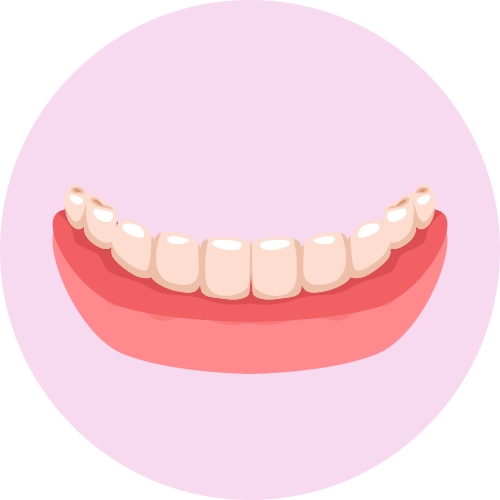
Full dentures
These are the classic style you might have seen chomping of their own accord in cartoons. They rest against your gums and replace all the teeth on your upper or lower jaw. While it’s common to see these false teeth in an upper and lower pair, they can fly solo too.
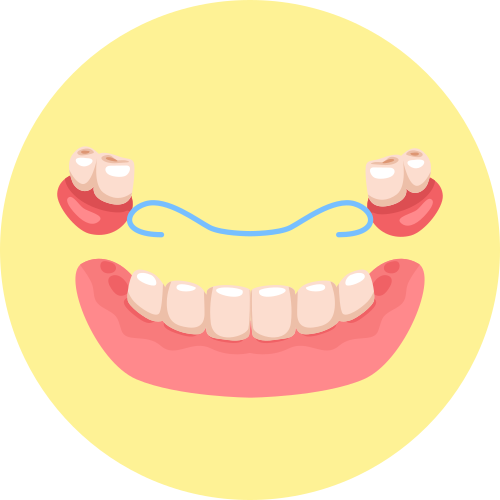
Partial dentures
If you’ve still got some homegrown teeth on your upper or lower jaw, a partial denture or plate might help fill in the gaps. These false teeth are held in place by a metal clasp that attaches onto your nearby natural teeth, so you don’t have to worry about them slipping out.
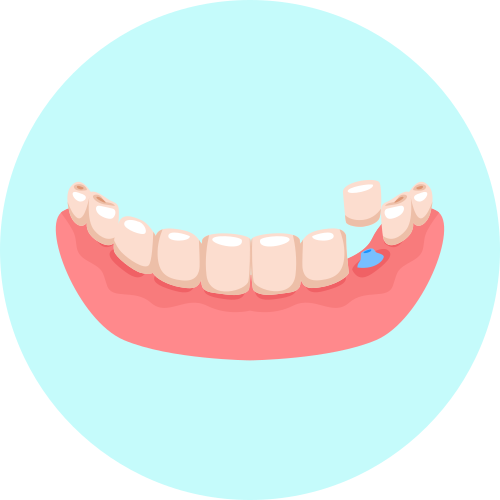
Implant-retained dentures
This style of denture is as versatile as a little black dress, replacing one or more of your natural teeth. A dental implant post is inserted into your jaw, and the false tooth sits on top of the post – like how a dental crown sits on top of your reshaped damaged tooth. You can still pop your denture out as needed, but the implant post will keep it firmly in place.
 Did you know?
In 2021, 8.3% of Australians aged 18 and over wore dentures. Dentures became a lot more common for those 55 or older, too.1Australian Research Centre for Population Oral Health – Adult Oral Health and Access to Dental Care in Australia, p28 While this doesn’t reflect too well on Australia’s attitudes to oral health, it does mean you aren’t alone if you need dentures.
How much do dentures cost?
How much your dentures cost – and how much you’ll be paying out-of-pocket for them – primarily depends on three things:
- how many teeth you’re replacing
- the materials used in your dentures
- if you go public or private, including if you have private health insurance.
As you can imagine, the more teeth you’re replacing, the more you can expect your bill to go up. For instance, a partial denture plate is likely to cost less than a full set of false teeth for both your upper and lower jaws.
Similarly, picking metal over plastic can mean your dentures are more expensive.
However, it’s choosing between public and private that can really make a difference, particularly since most dental care in Australia happens in private dental clinics.
Are dentures free through a public clinic?
Unlike for other kinds of health services, Medicare doesn’t stray into the world of dentistry very often. But there are still government-funded dental clinics that offer denture services.
The catch is that only about one in three Australians are eligible for public dental care,2Teeth.org.au – Government dental care and eligibility varies by state. You might also have out-of-pocket costs for your treatment.
At a public clinic, it’s unlikely you’ll get to choose your dentist, and more expensive or cosmetic treatments, like dental veneers, tend to be out of the question.
Does private health insurance pay for dentures?
Private dental clinics can choose to set their own fees – theoretically, two clinics on the same street could charge vastly different fees for the same treatment. But you might not need to pay for your dentures on your ownsome. If you have private health insurance, your insurer might cover some of the cost.
Whether or not a health fund covers dentures (and how much they cover) can vary. For instance, your health fund might pay only a percentage or a set amount of the bill up to an annual limit. Similarly, they might only help cover services from preferred providers. Being informed ahead of time can mean you aren’t surprised when you go to pay the bill. This can include reading over your policy documents or speaking with your insurer.
Going private for your dentures can mean you can choose your dentist (you might want to double check they do dentures and are a preferred provider for your health insurance), access a fuller range of treatment options, and maybe even get the benefit of the latest dental technology advancements.
Without set fees, it can be hard to narrow down exactly how much dentures cost. However, to give you an idea of how costs can shake out at public and private dental clinics, the table shows the amounts health funds and different public dental schemes covered for two partial denture items in 2023–24.
How much did private health insurance and public dental schemes cover for partial dentures?
| Private health insurance | Public dental care (Department of Veterans’ Affairs) | Public dental care (NSW Oral Health Fee for Service Scheme) | |
| Eligibility | Hold an extras policy that includes dentures | Veteran with a Gold Card or White Card from the Department of Veterans’ Affairs | NSW resident who is eligible for Medicare and holds (or is listed as a dependent on) a Health Care Card, Pensioner Concession Card, or Commonwealth Seniors Health Card |
| Amount covered: Clasp for partial denture (Item 731) | $24 (average) | $44.75 | $43.40 |
| Amount covered: Tooth for partial denture (Item 733) | $23 (average) | $36.80 | $35.70 |
Sources: Department of Veterans’ Affairs – Fee Schedule of Dental Services for Dentists and Dental Specialists; NSW Health – Oral Health Fee For Service Scheme (OHFFSS) Schedule of Fees; Private Healthcare Australia – Dental Health Insurance
Are there other out-of-pocket costs for dentures?
You might have additional out-of-pocket costs for your dentures if you have related oral health issues. For instance, you could need to have a damaged tooth removed before your dentures are fitted.
Are there other or ongoing costs after getting dentures?
Dentures can come with some additional and ongoing costs.
For starters, you might want to be prepared for a few follow-up appointments so your dentist can adjust your dentures for a correct fit. While this might mean some additional out-of-pocket costs, ill-fitting dentures can cause irritation and soreness, even leading to ulcers. Sorting things out at the start can mean less of a headache for you later on.
Once your dentures fit just-so, it’s not the end of your dentist–patient relationship. You’ll need to come back each year to check your dentures still fit correctly. Without those natural teeth, your mouth shape changes over time. Plus, even with no natural teeth left, you still need to look after your oral health.
Away from the dental clinic, you’ll likely have some ongoing costs to keep your dentures in tip-top shape. This can include buying special denture cleaning solution to remove bacteria from and disinfect your dentures. Just like brushing your teeth, cleaning your dentures should be a part of your daily routine.
 Helpful tip

Dentures don’t last forever – whether that’s from the material breaking down or your mouth changing shape – but it’s still important you do your bit to take care of them, particularly if you want to get your money’s worth. Some private health insurance policies have limits on how often they’ll replace dentures, like every three years. So, if you find yourself needing to replace your dentures sooner than expected, you might find yourself shouldering the full bill.
Andres Gutierrez
General Manager – Health
How long will I have to wait for dentures?
Your wait for dentures can depend on a few different factors. For instance, if you need any teeth removed before you get dentures, you might need to wait a few months for everything to heal.
Your choice of a public or private clinic is likely to be the biggest factor, though.
Public dental services in Australia have a reputation for long waiting lists, unfortunately. In 2022–23 the median wait for those on the public list to receive their first offer of care varied by state. However, it tended to be around 100 days, with folks in Western Australia topping out at a 486-day median wait.3Australian Institute of Health and Welfare – Oral health and dental care in Australia: Supplementary tables
If you’re visiting a private dental clinic with appointments readily available, you’ll likely have a shorter wait. But if you intend to use your private health insurance to help cover some of the costs, you’ll need to be across your waiting periods.
Unlike hospital waiting periods, insurers don’t have a maximum limit for extras waiting periods. Having said that, a competitive marketplace means you’ll likely see similar figures for different types of cover. In the case of major dental procedures, like dentures, waiting periods of 12 months are common.
What level of health insurance do I need to cover dentures?
We may have let the cat out of the bag in the last section – denture cover tends to come under major dental on extras policies. Typically, major dental also covers complex fillings, crowns, veneers, bridgework, and implants. Of course, what’s covered can vary between health funds and even policies, so pop on your reading glasses and dip into that thankfully-not-so-fine print of the policy documents.
If dentures aren’t a given for you right now, it’s still important to look after your oral health. While modern dentures are pretty good (and much better than ye olde tech of using animal ivory), it’s hard to beat the original product. So, you might want to look at a general dental extras policy to help cover routine dental services, like check-ups, cleans, and simple fillings.
Where can I find and compare health insurance?
If your teeth need a little TLC – or a complete do-over – iSelect is here to help. We can’t set you up with dentures, but we can make it super simple to compare a range of health insurance extras policies. All you need to do is use our online comparison tool or speak with one of our health insurance comparison experts on 1800 784 772.
Compare health insurance policies the easy way
Save time and effort by comparing a range of Australia’s health funds with iSelect







WE’RE HERE TO HELP
Need help with health insurance?
We can help you find a suitable product for your needs

Health Insurance & Tax
Tax Implications on Health Insurance
The Medicare Levy Surcharge
About the Life Time Health Cover Loading
The Private Health Insurance Benefit Codes
iSelect does not compare all health insurance providers or policies in the market. The availability of policies will change from time to time. Not all policies available from its providers are compared by iSelect and due to commercial arrangements, your stated needs and circumstances, not all policies compared by iSelect are available to all customers. Some policies and special offers are available only from iSelect’s contact centre or website. Click here to view iSelect’s range of providers