
.svg)


How Much Does Turbinate Reduction Surgery Cost in Australia?
How Much Does Turbinate Reduction Surgery Cost in Australia?





Written by
Tina Sendin
Edited by
Andrew Kemp
Reviewed by
Andres GutierrezCompare Health Insurance Policies
Save time and effort by comparing a range of Australia’s health funds with iSelect



Long story short
Public surgery is free, but patience is the price
If you hold a Medicare card, turbinate reduction surgery in a public hospital won’t cost you anything. The trade-off is that you’ll be placed on a waiting list that could last for months.
Going private offers speed and choice
Choosing to be a private patient means you get to pick your specialist and schedule the surgery sooner. However, you’ll likely face some out-of-pocket costs, even with private health insurance.
You could expect to pay around $800 out of pocket
Even with hospital cover, most patients face a gap payment for the specialist’s fee. This is on top of any hospital costs or excess your policy might require.
You need specific hospital cover
To claim benefits for turbinate surgery in a private hospital, your policy must include the ‘Ear, nose and throat’ clinical category, which is on bronze-tier policies and higher.
What is turbinate reduction surgery?
Turbinate reduction surgery is used to address the enlargement of turbinates and fix symptoms of nasal obstruction. The goal is to reduce the size of enlarged turbinates – if not to remove them altogether.
There are different ways to perform turbinate reduction surgery – from cauterization, coblation, radiofrequency reduction to open surgery.
Nasal turbinate reduction may be done with other nose surgeries like nasal septum surgery (or septoplasty), nasal polyp removal, or sinus surgery.
Let’s take a closer at what turbinates are and they affect your nasal cavity.
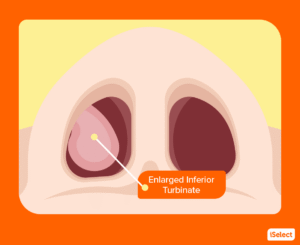
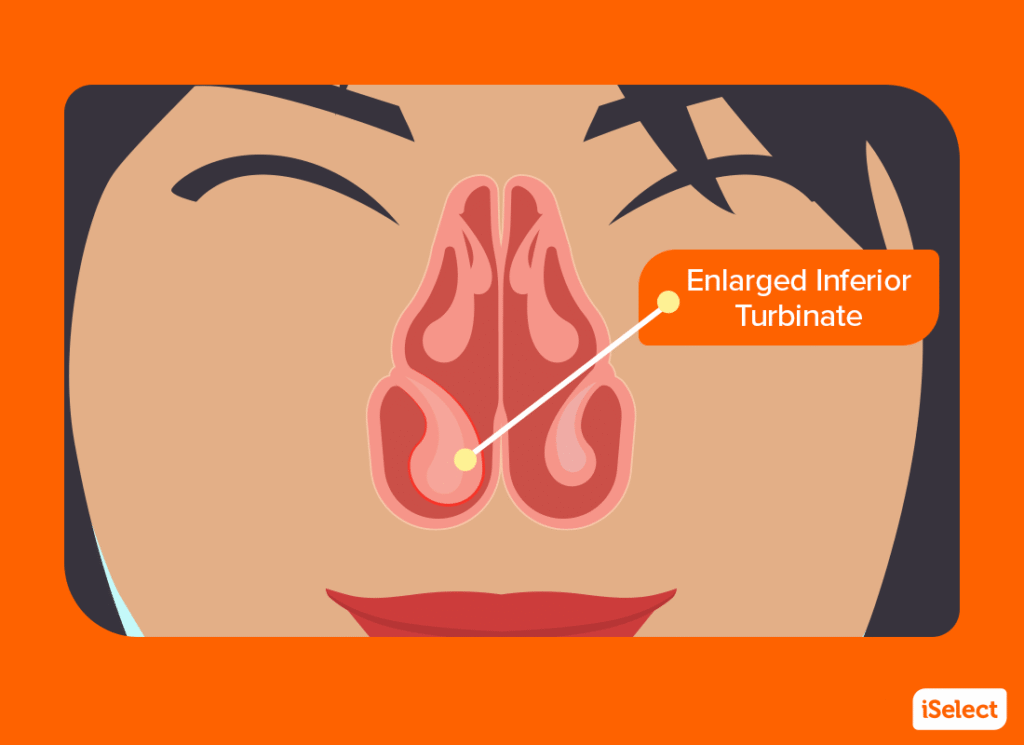
Turbinates are small, bony structures inside your nose covered in soft tissue. They warm, humidify, and filter the air you breathe – all thanks to the moist turbinate tissue that covers them and which is called nasal mucosa.
Sometimes, due to things like allergic rhinitis or colds and flu, the turbinates at the bottom of your nose can become permanently enlarged. This condition, known as inferior turbinate hypertrophy, can cause chronic nasal congestion, disrupt your sleep, and make breathing a daily struggle.
When treatments like nasal sprays, antihistamines, and other medications aren’t enough to provide relief, your doctor might recommend inferior turbinate reduction surgery. The goal is usually to reduce their size (and in some cases, remove them partially or completely) to improve airflow in the nasal passages while preserving their important functions.
What are turbinoplasty and turbinectomy?
While often used interchangeably, turbinoplasty and turbinectomy are two different medical procedures (although they have the same objective – to reduce the size of the turbinates). Turbinoplasty repositions and reshapes the turbinate to get rid of the obstruction, while turbinectomy is a surgical procedure to remove them either completely or partially.
With turbinectomy, the surgeon might use instruments such as microdebriders, debriders, and electric cautery to trim the soft turbinate tissues (and sometimes remove a part of the bone, too). This could be done through open surgery or with the use of an endoscope.
What’s the cost of turbinate reduction surgery in Australia?
You won’t pay anything for turbinate reduction surgery if you go through the public health system. For those using the private health system, most patients that have Medicare and private health insurance typically spend around $800 out of pocket on specialist fees, according to Medical Costs Finder. If uninsured, those costs climb to around $1,500. While hospital costs could be around $2,600, your private health insurance could cover some – or all – of this.
Does Medicare cover nasal turbinate surgery?
Yes. If you’re an Australian resident with a Medicare card, a medically necessary turbinate reduction surgery in a public hospital is covered. Medicare foots the entire bill for the surgeon, anaesthetist, and your hospital stay.
The catch is the wait. As this is typically considered an elective procedure, you’ll be placed on the public hospital waiting list. This wait can stretch from several months to even longer, depending on where you live and the urgency of your case.
You also don’t get to choose your surgeon.
Does health insurance cover turbinate reduction surgery?
Private health insurance could cover some of the costs while also allowing you to choose your own ear, nose, and throat (ENT) specialist and book your surgery at a time that suits you, effectively bypassing the public queue.
But even with a hospital policy, you could still expect some out-of-pocket expenses. Data from the Australian Government’s Medical Costs Finder show us what private patients typically paid in specialist fees for a turbinectomy in 2023–24.
Turbinate reduction surgery (turbinectomy) cost in Australia
| Medical Benefits Schedule (MBS) item numbers | 41693, 41692, 41689 |
| Typical specialists’ fees | $2,700 |
| Medicare benefits | $850 |
| Insurer typically paid | $710 |
| Typical out-of-pocket cost | $830 |
| % of patients with an out-of-pocket cost | 90% |
Source: Medical Costs Finder – Turbinectomy (remove small nasal bones)
Note: These are the amounts patients typically paid for these services, rounded to the nearest dollar. They do not include hospital payments such as excesses, co-payments, or other payments. These fees may vary depending on your situation. Not all patients had out-of-pocket costs; those who didn’t aren’t included in these figures. Data retrieved February 2026.
When you use private health insurance, the costs are shared:
- Medicare pays 75% of the government-set MBS fee for the specialist.
- Your health fund pays the remaining 25% of the MBS fee.
Then you pay the gap, which is the amount the specialist charges above the MBS fee.
Are there other out-of-pocket costs for turbinate reduction surgery?
Unfortunately, yes. While the table above gives you a snapshot on specialists’ fees for a turbinectomy, other hospital costs are not included in those numbers.
According to the 2023-24 data from the Medical Costs Finder, private patients who had turbinate reduction surgery typically spent $2,600 on their hospital stay and treatment. Private health insurance may cover all or part of these costs, but it’s prudent to talk to your health fund about what coverage could look like.
There are also other out-of-pocket costs that you might want to think about:
- Hospital excess: This is the amount you’ve agreed to pay up-front when you’re admitted, as set in your health insurance policy. For many health funds, the excess can range from $250 to $750 for singles, and up to $1,500 for family cover. A higher excess usually means lower ongoing premiums, but make sure the excess is affordable if you end up needing treatment.
- Co-payment: Some health funds require you to pay a set fee for each day you stay in hospital – known as a co-payment. For procedures like turbinate reduction, most patients go home the same day, but if there’s non-dissolvable packing in your nose, you might need to stay overnight for the packing’s removal the next morning.
- Medications: You might need some pain relief as part of your aftercare. Your specialist may also recommend saline sprays, nasal rinses, or dressings and these are generally out-of-pocket.
- Follow-up appointments: If you need further consultations with your ENT or a follow-up with another specialist (e.g. if you’re combining procedures), there could be additional consultation fees.
 Helpful tip

While your health fund may cover all or a portion of your hospital fees (accommodation and theatre costs for instance), there are other out-of-pocket costs worth discussing with your doctor, hospital, and insurer before locking in your procedure.
So, before you book your surgery, ask your specialist for a full breakdown of the costs, including their MBS item numbers. With these details, you can check with your health fund exactly what they’ll cover and what your final out-of-pocket expense will be.
And don’t forget: while the operation itself is a big up-front cost, remember to budget for some of the additional – sometimes overlooked – expenses as part of your recovery journey.
Andres Gutierrez
General Manager – Health
How long will I have to wait for turbinate reduction surgery?
In the public system, you might have to wait for a long time (which could be almost a year). But going private allows you to skip the public waiting queue and you could book the turbinate reduction surgery much quicker. Let’s dive deeper into wait times.
Public system
In the public system, you’re placed on an elective surgery waiting list. For non-urgent procedures like turbinate reduction, the wait can be lengthy.
There isn’t any government data available on waiting times for turbinate reduction surgery. But to give you an idea, a similar procedure called septoplasty has the highest median waiting time in the public system with 320 days (that’s almost a year). And it’s got the highest percentage of public patients waiting for more than a year.
Private system
You won’t have to wait as long as the public waiting queue, and you can choose your preferred specialists. This means you could get greater control and flexibility over your schedule and your medical team.
You might also want to keep waiting periods in mind. If you’re new to private health insurance – or you’re upgrading from a more basic policy – you’ll usually need to wait 12 months if your enlarged turbinates are considered a pre‑existing condition. But if you’re already covered and your symptoms have only recently started, the waiting period is typically just two months.
Frequently asked questions
What factors influence the cost of turbinate reduction surgery?
The main factors are your surgeon’s and anaesthetist’s fees, whether you use the public or private system, and the complexity of your procedure. For instance, a simple turbinate reduction surgery will likely cost less than one combined with other nasal surgeries like septoplasty (to fix a deviated septum).
Are there any hidden costs associated with turbinate reduction surgery?
Costs are generally transparent if you ask your healthcare provider the right questions up-front. Always request a full quote from your surgeon and anaesthetist and confirm coverage with your health fund to avoid surprises.
Is turbinate reduction worth it?
For many people suffering from chronic nasal obstruction, the surgery can be a gamechanger. The ability to breathe freely, sleep better, and use nasal sprays less frequently often makes the procedure and its associated costs worthwhile. Like any other medical procedures, there are potential complications like nosebleeds or increased nasal discharge, so it’s worth weighing the potential benefits and risks with your ENT specialist.
Sniff out your options for hospital cover
Before you move forward, it’s worth having a look at your hospital cover. Making a decision without all the facts is like trying to breathe with a blocked nose – frustrating and inefficient. Getting up to speed on your options can let you breathe more easily, knowing you’ve got the right health cover for your needs.
Compare private health insurance policies with iSelect by using our comparison tool or by speaking with one of our health insurance comparison experts on 1800 784 772.
Compare health insurance policies the easy way
Save time and effort by comparing a range of Australia’s health funds with iSelect







WE’RE HERE TO HELP
Need help with health insurance?
We can help you find a suitable product for your needs

Health Insurance & Tax
Tax Implications on Health Insurance
The Medicare Levy Surcharge
About the Life Time Health Cover Loading
The Private Health Insurance Benefit Codes
iSelect does not compare all health insurance providers or policies in the market. The availability of policies will change from time to time. Not all policies available from its providers are compared by iSelect and due to commercial arrangements, your stated needs and circumstances, not all policies compared by iSelect are available to all customers. Some policies and special offers are available only from iSelect’s contact centre or website. Click here to view iSelect’s range of providers