
.svg)


What’s the Sun Tax?
What’s the Sun Tax?





Written by
Rachel Gregg
Edited by
Ellie Garran
Reviewed by
Julia PaszkaCompare Electricity & Gas Plans
Save time and effort by comparing a range of energy plans with iSelect



Long story short
The sun tax isn’t really a tax
It’s a term for the two-way pricing system being applied to certain states. It charges you a small fee for exporting solar during low-demand times.
Where and when will the sun tax happen?
As of September 2025, the sun tax is only in place for solar-powered homes in SA and NSW, with charges and some credits offered during certain hours.
Solar is still worth it
Even with the sun tax in place, solar can still save you money, especially if you use your generated energy during the day or install a battery.
What’s the sun tax?
First things first, the sun tax isn’t actually a ‘hand over your money to the ATO’ type of tax (phew). It’s a two-way pricing method for homes that generate solar power; ‘sun tax’ is just the nickname it’s been given. It essentially means that if you send solar power to the grid during low-demand times (10 am – 3 pm), instead of the credit you might’ve once got, you’ll now be charged.
Imagine your friend won’t stop baking. At first, being their guinea pig is great – cookies and banana bread galore. But by the tenth batch of half-baked experiments in a week, your stomach’s had enough. That’s what happens when the grid gets flooded with excess solar in the middle of the day. The sun tax steps in to balance it out, making sure the grid doesn’t get tipped into chaos with these excess exports. So instead of endless half-set panna cottas, you only get the best bakes when they’re actually wanted.
With over four million Australian homes jumping on the solar train, the easy option to sell back excess power during the day is causing more issues than it’s solving. It means the main grid could see more instability issues, like difficulty maintaining voltage levels and even possible blackouts. While the sun tax might seem a bit negative, it’s about keeping the grid steady and prices fair. It also encourages solar users to make the most of their own energy at home, rather than giving it all away.
How does the sun tax work?
The sun tax is a two-way pricing method. So, if you export solar energy to the grid during peak daylight hours (10 am to 3 pm), you could cop a small charge instead of a credit. The idea is to nudge people towards using their own solar during the day or storing it in a battery for later. The exact cost could differ from one distributor or provider to another. Looking at the higher end (using SA Power Networks as an example), average households could be looking at an extra $1.50 per month on their bill. Not exactly a budget breaker.
Some providers are adding free threshold periods to soften the blow. This means you’ll be allowed to export a certain amount during peak hours without paying a cent. Others (like Ausgrid) even offer reward credits, so if you export solar during high-demand times (4 pm – 9 pm), you’ll get paid a nice little bonus.
Where is the sun tax applicable?
The sun tax has been talked about for a few years, but it’s only in 2025 that we’re seeing some action. But it’s not full steam ahead for all states just yet.
As of September 2025, there are only a few Australian states that are introducing or using the sun tax. The SA sun tax and the NSW sun tax were rolled out on July 1, while other states don’t have any concrete plans in place yet.

NSW
NSW rolled out its sun tax or two-way tariff in July 2025. The way you’re charged depends on your distributor and provider, so it might differ slightly, but here’s how Ausgrid explains it. For applicable customers, you can export 200 kWh of solar energy during peak daylight hours (10 am – 3 pm) for free. But once you hit this monthly limit, there’s a small charge. But it’s not all bad news; if you export your solar energy between 4 pm and 9 pm, you’ll get a credit. Right now, Ausgrid sets the charge at 1.23 cents/kWh and the reward at 3.85 cents/kWh, but retailers can decide how to bundle these prices their own way.

SA
With the highest uptake of rooftop solar in the world, SA has also started charging a sun tax as of July 2025. Like the sun tax in NSW, the charge applies if you export solar during daylight hours between 10 am and 4 pm. The good news? You get a daily threshold before the charges kick in. Smart meters get 9 kWh free, while accumulation meters get 11 kWh, and anything you don’t use rolls over to the next day in your billing cycle. After you hit the threshold amount, the current solar tax charges are at 1 cent/kWh (interval meters) and .75 cents/kWh (accumulation meters).
Other states
Other states like QLD or VIC haven’t gone down the sun tax road yet, but they do have solar feed-in tariffs. Feed-in tariffs were originally designed to encourage solar uptake by paying homes for exports at different rates depending on demand (peak, off-peak and shoulder times). But they were never meant to stick around. And as more homes install solar, the rates are dropping. Just like the sun tax, the goal of feed-in tariffs is to nudge households towards using more of their solar instead of flooding the grid in the middle of the day. So even without the sun tax, states like QLD or VIC are still shifting the focus from exporting to self-consumption.
 Helpful tip

While it might sound like the sun tax will charge you for using solar, it’s only in play when you export your leftover solar during certain (low demand) times. The easiest way to stay out of its playing field is to soak up your solar first before sending it off to the grid. So, consider things like setting your washing machine, dishwasher or pool pump during the day, so you’re using the power your panels are pumping out right there and then.
Julia Paszka
General Manager – Utilities
What does it mean if my home is impacted by the sun tax?
If you live in NSW or SA and you export a lot of solar during the day, you could start seeing some changes soon. But if you’re already using most of your solar or have a battery set up, the impact could be pretty minor. At the end of the day, it really depends on how your home uses its solar power. But to help paint a clearer picture, here are two fictional scenarios from NSW solar-powered homes to lay it all out.
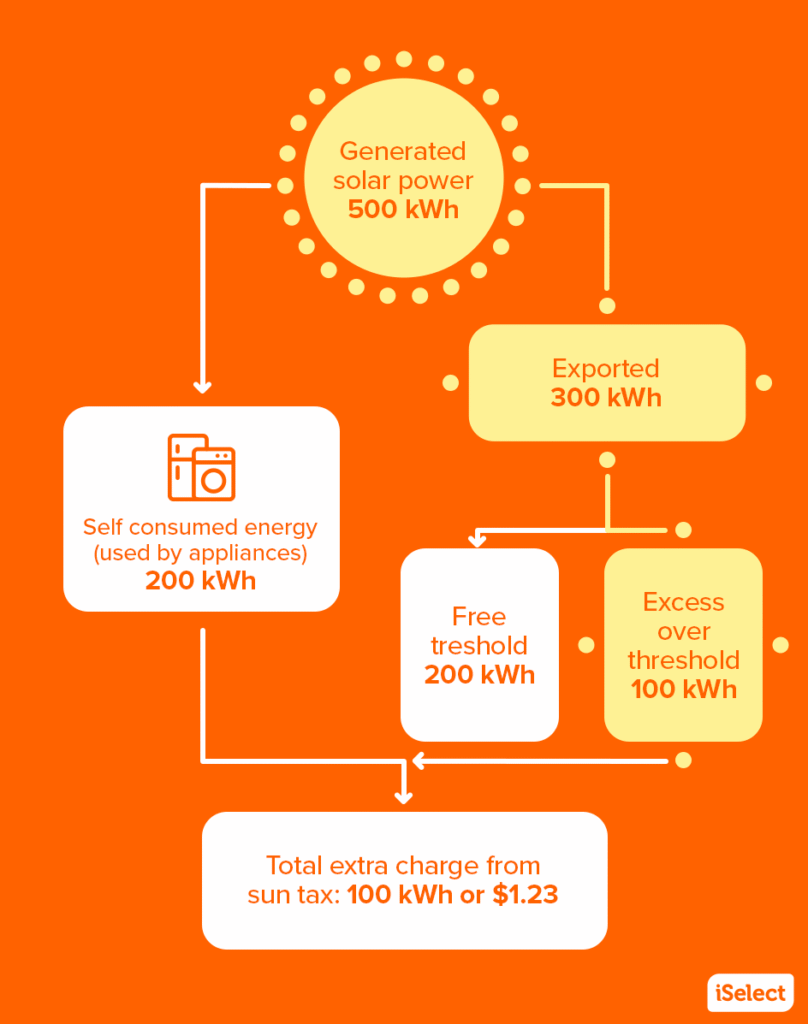
Fictional scenario: Joel
Joel generates 500 kWh from his solar panels every month, but because he’s out at work most days and hasn’t set up timers, he only uses about 200 kWh at home. The other 300 kWh gets imported during the day. Under the sun tax, he gets to export his first 200 kWh for free, so he’d get charged for the remaining 100 kWh. That means he’d be looking at an extra $1.23 charged to his monthly bill.
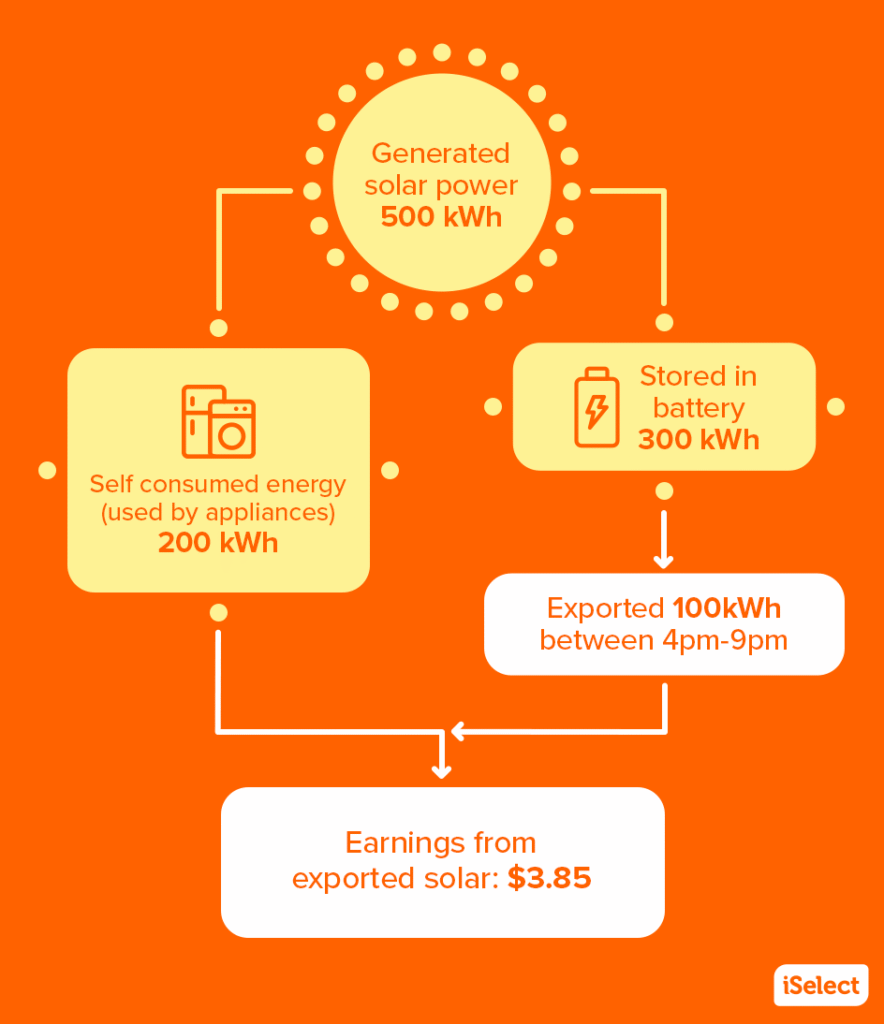
Fictional scenario: Ami
Ami’s got her solar setup sorted. She’s got solar panels, a battery, and smart self-consumption habits. Monthly, she generates 500 kWh of solar power, uses 200 kWh during the day by setting her energy-hungry appliances, and stores the rest in her battery. She ends up exporting 100 kWh from her battery in the evening (4 pm to 9 pm), which earns her a credit of $3.85 to her monthly bill.
Is solar still worth it for my home?
It’s definitely still worth it, especially if your goal is to create a smaller carbon footprint and an energy-efficient home! The real trick is how you use your solar energy. That is, it makes sense to self-consume as much as you can and lean less on the main grid once the sun is down (unless you’ve got a solar battery). If you’re using the solar you’re generating, a solar panel system can still pay for itself in around three to five years – that’s without a battery, too. Plus, the solar tax won’t cancel out the incentives and rebates available for solar panel systems and batteries. So, you can still see those savings when it comes to setting up your solar in the first place.
How can I reduce the sun tax?

Self-consumption
Solar soaking or self-consumption is one of the best ways to reduce the impact of the sun tax. Using your solar energy as it’s generated instead of exporting it out is the simplest way to cut down the sun tax charges. And it means that you’ll be getting the most out of your solar panels. Changing a few habits, like running energy-heavy appliances (dishwashers, cooling or pool heaters) during the day, can really make all the difference. If you’re out most of the time, see if you can set timers for an easy win.
Solar batteries
If you haven’t already, adding a solar battery could be a game-changer to reduce sun tax charges. A solar battery stores excess power your panels make during the day (so you don’t get charged for it), and you can use it at night. Even better, if your provider offers evening reward credits, you can export some of that stored power after dark and earn a little bit back on your bill.
Plug into the brighter side by comparing energy plans with iSelect
Whether your home is fitted up with all the solar panels you need or you’re just looking to be more energy efficient, your energy plan could be the secret to unlocking your home’s energy potential. If you want your energy plan to support your energy usage goals, it could be time to see what’s out there and find a match for your needs. At iSelect, we can help you compare from a range of plans and providers. Just jump online to start comparing or call one of our energy comparison experts on 1800 664 532.
Get started on comparing energy plans today!
Save time and effort by comparing a range of energy plans with iSelect





iSelect does not compare all energy providers or plans in the market. The availability of plans may change from time to time, depending on who iSelect’s providers are and what plans they make available to iSelect. Not all plans made available from iSelect providers may be compared by iSelect either due to commercial arrangements, area or availability, so not all plans or providers compared by iSelect will be available to all customers. Some plans and special offers are available only from iSelect’s contact centre or website. Energy plans are available only for properties located in eligible areas of Victoria, New South Wales, South East Queensland, South Australia and ACT. Click here to view iSelect’s range of providers.