
.svg)


Solar Feed-in Tariffs
Solar Feed-in Tariffs





Written by
Rachel Gregg
Edited by
Laura Crowden
Reviewed by
Julia PaszkaCompare Electricity & Gas Plans
Save time and effort by comparing a range of energy plans with iSelect



Long story short
Australia’s solar power surge
By 2025, renewables will power 48% of Australia’s electricity – three times more than in 2015.1Clean Energy Council – Emissions reductions delivered by renewable energy As of 2024 Australia also generated 18% of the world’s renewable energy.2ABC News – Survey of the world’s solar shows global boom
Feed-in tariffs put money back in your pocket
Solar feed-in tariffs (FiTs) pay you for excess energy you send back to the grid. With over 4 million Australian homes already on solar, it’s a bright idea shared by many Aussies.3Clean Energy Regulator – Small-scale installation postcode data
Not all FiTs are created equal
Rates and FiT plans vary by provider and state. Some offer a single flat rate, while others use time-of-use pricing — higher payouts in the evening, lower during the day.
What affects your FiT rate?
Wholesale electricity prices, government or distributor set minimums, grid costs, and even where you live can impact how much you get paid for your solar energy.
Australia’s Solar Power Game
When you think of Australia, chances are the heat and sunshine come to mind pretty quickly. So, it makes sense that we’re putting all that sunlight to good use with a target of 82% national renewable electricity generation by 2030.4Australian Energy Council – The 82 per cent national renewable energy target – where did it come from and how can we get there? Ambitious? Sure. Achievable? Absolutely, with the Australian Government working hard to make switching over to solar power more appealing than ever through a range of rebates and incentives.
And while there’s definitely still work to do, we’re making solid progress. As of June 2024, Australia generates 18% of the world’s renewable energy.5ABC – Survey of the world’s solar shows global boom By the end of 2025, renewables are expected to make up about 48% of Australia’s total power generation, nearly three times larger than in 2015.6Clean Energy Council – Emissions reductions delivered by renewable energy By not sticking to business as usual and continuing to rely solely on coal-fired power plants, we’ve saved 200 million tonnes of CO2 since 2015.7As above
You can see in the graph above how much renewables (measured in megawatts) have been put forward over nearly the past decade, and how much we’re slowly starting to back away from coal and unrenewable sources. But switching to renewables isn’t just about being kind to the planet, it can also be a win for your wallet. With feed-in tariffs, government rebates, and lower electricity bills, solar can pocket homeowners some serious savings. About 4.018 million Aussies have already jumped on board the solar bandwagon since 2001, so what’s stopping you from making the switch?8Clean Energy Regulator – Small-scale installation postcode data
What is a solar feed-in tariff?
A feed-in tariff (FiT) is basically a thank-you payment for sharing your unused solar energy with the grid. Most homes generate more solar power than they actually use — yes, even if you’re running the dishwasher, air con, and washing machine all at once. Instead of that extra energy going to waste, FiTs let you send it back to the grid in exchange for a little extra cash off your power bill.
FiTs can be especially handy in summer, helping you blast the air con guilt-free without having to worry about a sky-high power bill. And come winter? Any money saved during the summer thanks to your solar panels can be put towards paying your higher winter bills when you’re cranking the heater during gloomy weather.
While the exact feed-in tariff rate will vary from one provider to the next, every little bit still adds up to savings on your next bill.
How do FiTs work?
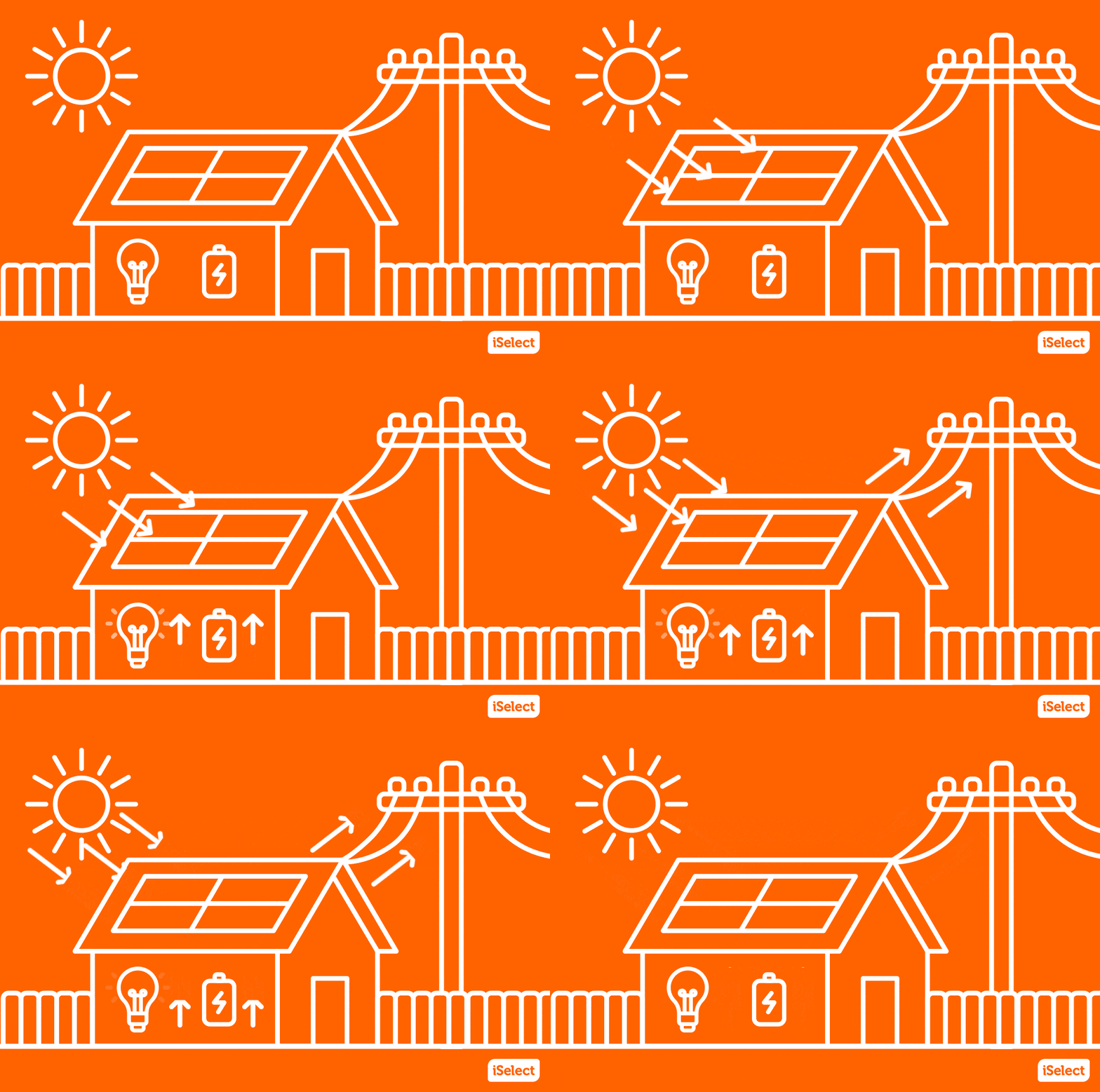
When you have a solar panel system, your electrical appliances like your air con, fridge or TV, will always get first dibs on the power you’re self-generating. If there’s leftover power, it either goes into your battery (if you have one) or back to the grid to help power other homes and businesses. Now instead of you giving that power back for free, your provider gives you the option to move onto a feed-in tariff (FiT), giving you money back for that otherwise unused power.
A FiT payment is calculated in cents per kilowatt-hour (c/kWh), meaning any power you send back, earns credits off your bill. It’s also why FiTs are sometimes called buy-back rates since your provider is literally buying your home’s self-generated power back from you.
Unlike government solar rebates, FiTs are paid by your energy provider, not the government. In the same way that the Victorian Default Offer and Default Market Offer set a price cap for your electricity plan, government bodies (like the Essential Services Commission in Victoria) or your distributor could set a minimum price, but this differs from state to state.9Essential Services Commission – Minimum feed-in tariff Below is a quick summary of how FiTs differ between states.
What Solar Feed-in Tariffs look like in your State
| VIC | Two types of government-regulated feed-in tariffs (flat rate of time-varying). |
| NSW | No mandatory minimum and customers can search for competitive rates. |
| ACT | No mandatory minimum and customers can search for competitive rates. |
| QLD | No minimum feed-in for South East Queensland where customers can search for competitive rates.Mandatory minimum for regional QLD determined annually. |
| TAS | No mandatory minimum and customers search for competitive rates. |
| WA | Different programs for Western Power and Horizon Power, WA’s only two distributors. |
| NT | Solar buy-back through main distributor PowerWater. |
| SA | No mandatory minimum and customers search for competitive rates. |
Source: Solar Choice – Compare Solar Feed-in Tariffs State by State (as of June 2024)
How are FiTs calculated?
Not all solar FiTs are created equally. Each provider will have their own rates but on top of this, they’ll also have plans that calculate your credits differently. These will either be a standard or time-of-use feed-in tariff and which one you are on can make a real difference to your solar savings.

Standard
Think of this as the “set-and-forget” option. Just like a single-rate electricity plan, a standard FiT pays you one flat rate for every kilowatt-hour (kWh) of solar you send back to the grid and it doesn’t matter if it’s midday or midnight (not that your panels are doing much at midnight). When your bill rolls in, you’ll see one simple figure showing how much power you exported and the total credit you earned.
If you’re on one of these plans, it’s likely your electricity bill will even have “solar” in the name, so it’s worth checking your provider’s fine print to confirm what type of FiT you’ve got.

Time of use
Now, if you like to be a bit more strategic with your energy use, a time-of-use FiT could be the right fit for you (pun intended). As the name suggests, instead of one flat rate, the price you get for your solar power changes depending on the time of day.
Whereas electricity time-of-use plans have off-peak hours to encourage people to use electricity in quieter times, solar alternatives encourage households to use their own solar-generated power first while the sun’s at its prime. This means a lower rate at midday but once the sun’s day is over, you’ll get a higher rate in the evening (around peak hour) for any power you can feed back into the main grid. This can be particularly rewarding for those with a battery attached to their solar panels.
Come bill time, if you’re on a time of use FiT you’ll see all of your usage spilt into categories like peak, off-peak and maybe even shoulder periods. Each of these will have its own rate charges which will be added to your final credit for your exported solar-generated power. It’s a bit more complex than a standard FiT, but if you’re clever about when you use (and don’t use) electricity, you can make it work in your favour.
Factors that might affect your FiT?
If you’re wondering why your mate in the next state has a better FiT rate than you, there are likely a bunch of different reasons at play. Firstly, the minimum tariff rate set by your state or provider (if they have one) impacts each provider’s pricing for FiTs. While this acts as a baseline, individual providers can choose to offer more on top of this minimum rate.
Declining feed-in tariff rates will also have a part to play in all this. FiTs were originally created to be temporary and help encourage solar installation in Aussie homes. But now that solar is everywhere and the need to create demand is lowering, so too are FiT rates. While that may be frustrating, remember the real benefit of solar is using it to cover your own usage, and your extra energy back into the grid should be viewed as just an added bonus.
FiT earnings also depend on a few other things, like the size of your solar, wholesale electricity prices, grid costs and retailer margins. There are a lot of individual factors at play, which is why it’s always important to keep one eye open when it comes to comparing solar plans.
 Helpful tip

Feed-in tariffs aren’t what they used to be! If you jumped on the solar bandwagon early, you might still be getting a higher rate, but for newer systems, feed-in tariffs are generally much lower than what you pay for electricity from the grid. That means it’s smarter to use your solar power while it’s being generated rather than selling it back to your provider. Unless you’re on an older gross metering setup (which pays you for everything your system produces), running appliances during the day could help you get the most bang for your buck from your solar panels!
Julia Paszka
General Manager – Utilities & Credit Cards
How can I switch to a solar plan at my home?
Switching to a FiT plan is pretty straightforward, but there are a couple of things to check off first. Of course it might be stating the obvious, but first you’ll need a solar panel system installed. Once you’ve got this requirement, it’s time to compare solar FiT plans out there to find your best match.
Once you’ve found a solar FiT plan you like, you’ll need to submit an application to the provider (if you haven’t already). Beforethe provider gives you the green light for that particular plan and FiT, they will want to make sure your solar system is up to scratch. That means it needs to be properly connected to the grid, installed to meet Australian safety standards, and within their size limits (which is usually around 10-15kW for most homes). If everything looks good, you’ll be on your new FiT plan in no time.
Which FiT is the best choice for my house?
Just because you’ve got solar panels installed, doesn’t mean your electricity provider automatically puts you on the most suitable plan. Some will switch you over to a solar plan by default, but that doesn’t always mean it’s the best fit for your setup—or your wallet.
While most Australians have a choice when it comes to their solar electricity plan, it isn’t the same for everyone. Most providers and states offer net FiTs, which means you only get paid for the extra solar power you don’t use. However, some states like ACT and NT still adopt an older type of FiT: a gross feed-in tariff. A gross FiT gets you to pay for every kW of electricity your panels produce (even what you’ve used yourself). So, instead of one bill, in ACT and NT, you’ll end up with it split into two: one for the solar power you generated from your gross FiT and another for the actual energy you’ve used.
Moral of the story? Just like a flat white and americano aren’t the same, enough though it’s all still coffee, neither are your FiTs. So, the best option is to search around for a solar plan that makes the most sense for your home.
Make the most of your solar with iSelect
Already using the sun’s power to your advantage? Don’t let that extra energy go to waste, make it work even harder for you. A good feed-in tariff can help turn your sunshine into some savings, but not all solar energy plans are as generous as others. Which is why it’s important to compare plans out there.
If you want to squeeze every last dollar out of your sun-powered setup, start comparing online from a range of solar plans and providers with iSelect. Or if you want to chat with a friendly voice instead, call our comparison experts at 1800 664 532 to get your solar working better for you, not the other way around.





Get started on comparing energy plans today!
Save time and effort by comparing a range of energy plans with iSelect
iSelect does not compare all energy providers or plans in the market. The availability of plans may change from time to time, depending on who iSelect’s providers are and what plans they make available to iSelect. Not all plans made available from iSelect providers may be compared by iSelect either due to commercial arrangements, area or availability, so not all plans or providers compared by iSelect will be available to all customers. Some plans and special offers are available only from iSelect’s contact centre or website. Energy plans are available only for properties located in eligible areas of Victoria, New South Wales, South East Queensland, South Australia and ACT. Click here to view iSelect’s range of providers.