
.svg)


How to Read Your Gas Bill
How to Read Your Gas Bill





Written by
Rachel Gregg
Edited by
Ellie Garran
Reviewed by
Julia PaszkaCompare Electricity & Gas Plans
Save time and effort by comparing a range of energy plans with iSelect



Long story short
Understanding your gas bill helps you stay in control
Understanding your usage and how seasonal changes and supply charges add to the mix makes it easier to know how your bill still stacks up.
Gas bills can vary more than you think
Different billing periods, seasonal spikes, and retailer pricing can all explain why your bill might look higher or lower than usual.
Each page of your bill tells you something different
From account details and usage graphs to laying out exactly how you’ve been charged, knowing what each section of your bill means makes the whole thing a lot less confusing.
Why is it important to understand what’s on my gas bill?
If you’ve ever opened up your gas bill and thought, ‘What on earth am I looking at?’ – well, you’re not alone. But getting a handle on what exactly your gas bill covers (more than just the amount and due date) can really be worth it. Think of it like a jigsaw puzzle. Once all the pieces, like usage, supply charges, and seasonal changes, join together, the bill and your usage patterns start to make sense. And once you understand where your money’s going, it’s much easier to compare gas plans and spot whether you’re potentially paying more than you need to.

Usage charges
Usage charges are based on how much gas you use. They’re measured in MJ (megajoules) or m³ (cubic meters). Prices can shift depending on things like wholesale gas prices, seasonal demand, and retail pricing.

Daily supply charges
Your daily supply charge is a daily fee to stay connected to the main gas line. It covers things like maintenance, emergency services, and safety checks. It’s a permanent part of your bill, so you’ll pay even if you’re on holiday.

GST (goods and services tax)
The GST is a standard 10% tax, set by Australian taxation laws, that’s added to the total of every gas bill across Australia.
Why gas bills might differ

Usage changes with seasons and behaviour
Your gas bill won’t be the same across the entire year, your winter bill will likely look a lot scarier than your summer one. Some retailers also charge differently depending on the season, which could bump things up or down on your bill.

Billing periods differ
Gas bills aren’t always for the same number of days. Most bills are sent out quarterly or, in Victoria, every two months. Sometimes, though, they only cover 28 or 35 days, depending on your provider.
How to read your gas bill
Page 1
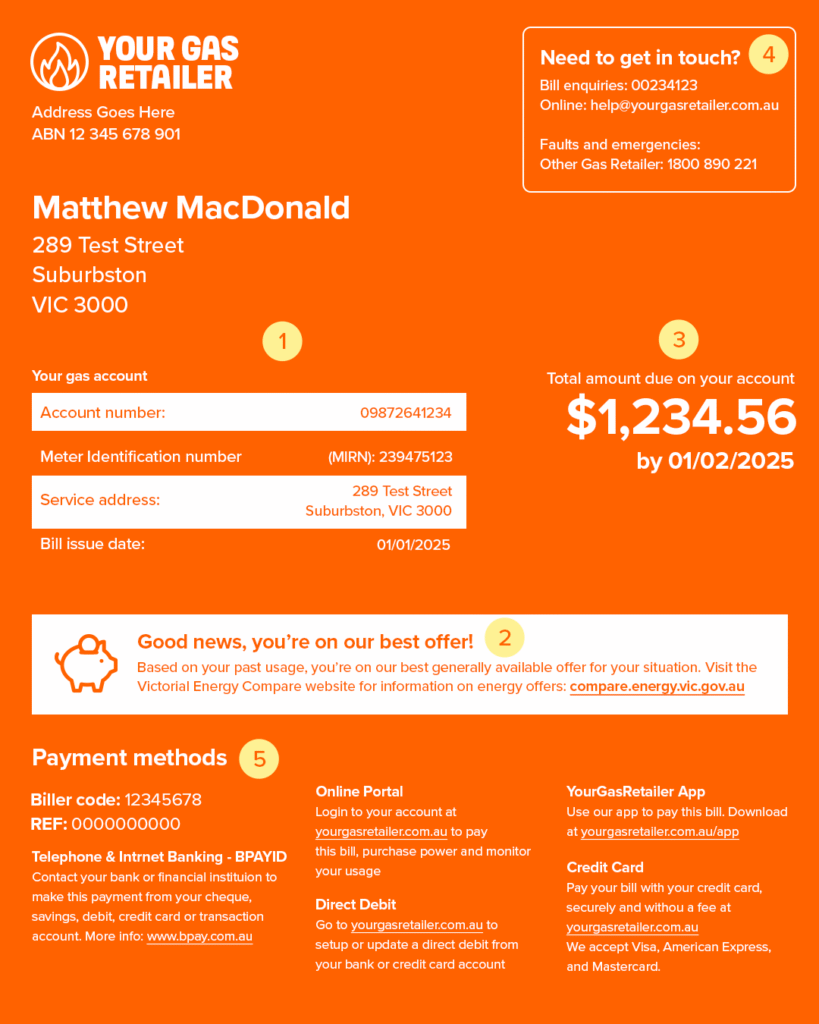
1 – Account details
This section shows your account number with your retailer, invoice number, supply address, and the identification number for your meter (MIRN for Victorians and DPI for everyone else). It also includes your mailing address in the top left corner.
2 – Best offer
This is a short section that tells you whether you’re on the best offer from your retailer. This is a mandatory section that will be on all your bills. If you aren’t on the best offer, this section should tell you how to switch to one that is.
3 – Bill amount
This section shows your bill amount and due date.
4 – Get in touch
In this section, you’ll find contact details for your retailer. Often, a few numbers are listed here for general enquiries, faults, or emergencies.
5 – Payment options
This section outlines all the payment methods available, as well as a reference barcode for paying in person.
Page 2
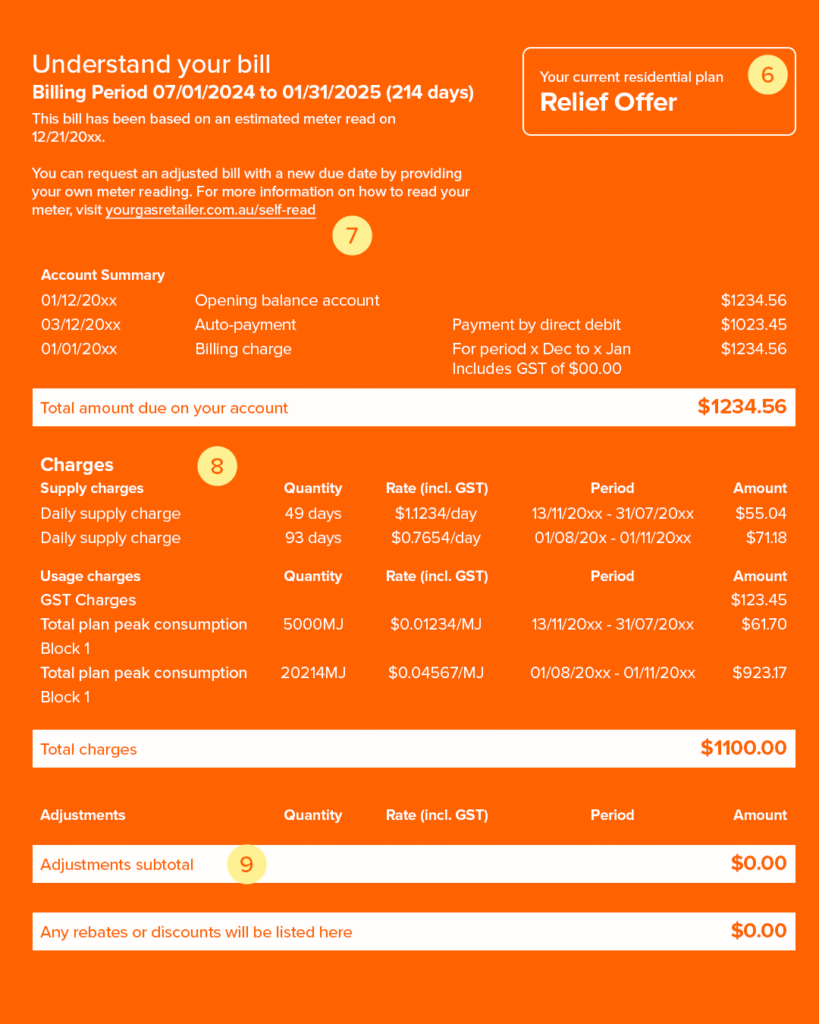
6 – Plan summary
This section lists your current plan, and any discounts or features that come with it.
7 – Understanding your bill or account summary
This section summarises your past charges or transactions and your closing balance as of your current bill.
8 – Charges for the period
This section shows your usage and supply charges throughout the billing period. This is broken down into two parts. The first part shows your supply charge by the day, and the second lists the different components of your tariff, like seasonal rates and peak/off-peak times.
9 – Concession or rebates
Also called the adjustment section, this section lists any concessions, credits, or other energy discounts used during your billing period.
Page 3
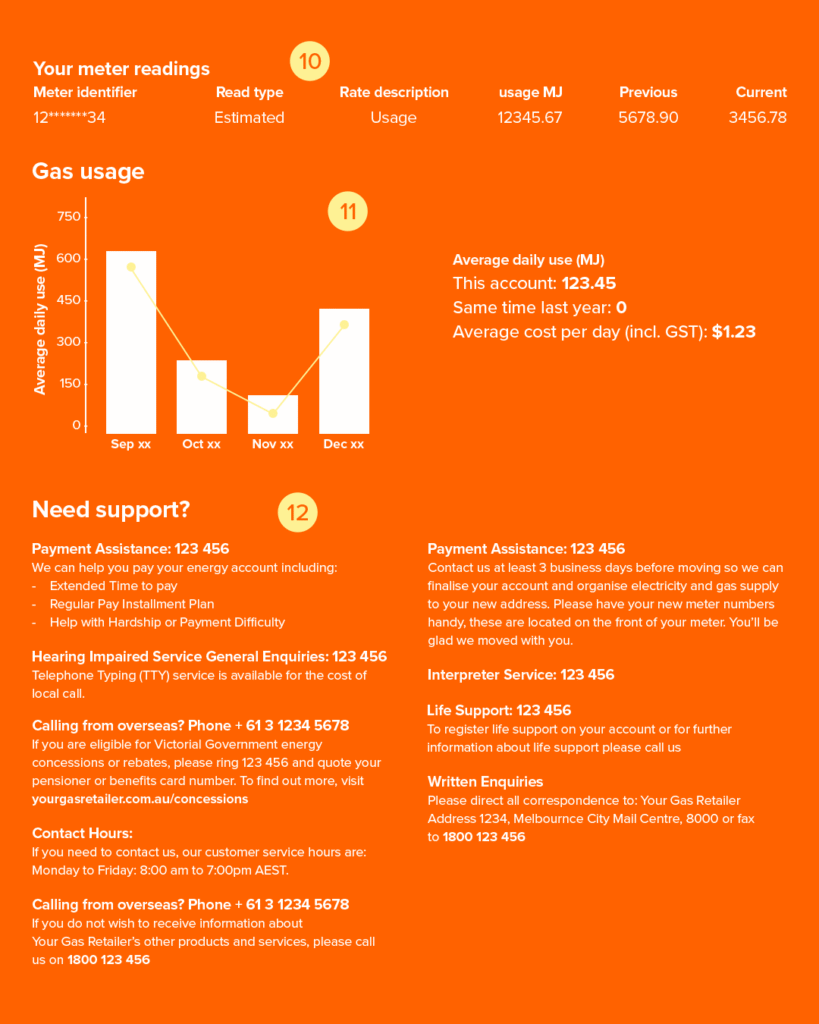
10 – Meter reading info
This section tells you your previous and latest gas meter readings, your meter number, and the next planned meter read date.
11 – Usage information
Usually, this section includes a graph of your past gas usage. It shows how you’ve been using your gas over a certain period, so you can see patterns or compare it with previous years. It should also provide an average daily usage amount.
12 – More information
Also sometimes named ‘Need support’, this section gives you information related to payment assistance, life support, interpreter services, and more.
Note: This gas bill is used as a fictional example. Bill layouts and numbering vary from one provider to the next.
What about LPG gas bills?
If you’re on LPG (Liquefied Petroleum Gas), most of your bill will look the same, with the account details, due date, and payment summary all lining up with a standard gas bill. The main difference is in the bill charges section. Instead of MJ, you’ll see the number of gas bottles used in your billing period, with a total cost at the end.
 Helpful tip

Always check the ‘Best offer’ section on your bill. This is a mandatory section in most states, and it can be a handy shortcut to savings. This section shows whether you’re already on your retailer’s lowest-priced plan, and if not, how much you could save by switching. Just a quick check on each bill can help you make sure that you’re not paying more than you need to.
But just a heads up: this section will only compare your plan with other plans from the same provider. If you want to see how it stacks up against other providers, we can help with that!
Julia Paszka
General Manager – Utilities
Compare energy plans without the headache
Once you’ve cracked the code to your gas bill, the real win is making sure your plan aligns with your household’s usage style (and of course, your budget). With iSelect’s online tool, you can compare from a range of plans and providers to easily see if it’s time to switch things up, or stay where you are. You can also call our comparison experts at 1800 664 532 for help.
Get started on comparing energy plans today!
Save time and effort by comparing a range of energy plans with iSelect





iSelect does not compare all energy providers or plans in the market. The availability of plans may change from time to time, depending on who iSelect’s providers are and what plans they make available to iSelect. Not all plans made available from iSelect providers may be compared by iSelect either due to commercial arrangements, area or availability, so not all plans or providers compared by iSelect will be available to all customers. Some plans and special offers are available only from iSelect’s contact centre or website. Energy plans are available only for properties located in eligible areas of Victoria, New South Wales, South East Queensland, South Australia and ACT. Click here to view iSelect’s range of providers.