
.svg)


How to Read Your Gas Meter
How to Read Your Gas Meter




Written by
Rachel Gregg
Edited by
Ellie Garran
Reviewed by
Julia PaszkaCompare Electricity & Gas Plans
Save time and effort by comparing a range of energy plans with iSelect



Long story short
Gas meters help you keep track of your usage
Your gas meter is there to keep track of the gas usage on your property, so your provider can work out your bill.
If your distributor can’t get in to read your gas meter, you could get an estimated bill
These are based on your past usage, but they aren’t always 100% accurate.
You can submit your own gas meter reading
If you get an estimated bill and don’t agree with it, you can take a reading of your gas meter and submit it to your provider, which could change your bill amount.
What is a gas meter?
Your gas meter is a little box on your property that keeps track of how much gas your home uses. Your distributor reads it and uses that info to work out your bill. There are different types of gas meters, but at the end of the day, they’re there so your provider knows what to charge you at the end of your billing period.
Every gas meter comes with its own ID number to connect it to your account. If you live in VIC, QLD, SA, or WA, this is called a meter identification reference number (MIRN). You’ll see it at the top of your gas bill under your details or on the gas meter itself. If you live in New South Wales, this ID number is called a delivery point identifier (DPI).
How often is my gas meter read?
Most gas meters are read every two to three months, except in VIC, where it’s usually every two months. A contract meter reader from your distributor will come by to do the reading. This timeframe isn’t set in stone, legally – you only have to have one reading done every 12 months – but you’ll often see it done more than this. You can check your bill (under your meter reading info) to find out when your next gas meter reading is due.
Why might I need to read my own gas meter?
It’s not always up to the pros to get your gas readings; if you’re eligible, you can read your own meter and submit it to your provider. This will most likely happen if you get an estimated bill, especially if you reckon you haven’t used as much gas as your provider’s estimated.
So why do estimation bills happen in the first place? Usually, it happens when your local distributor can’t read your meter. This could be because of a locked gate, an excitable dog, jungle-level foliage or severe weather that stops them from getting onto your property. When this happens, your provider will look at your previous usage history to make a close estimation.
But these aren’t always 100% right. You could end up with a higher bill if they overestimate, or a catch-up bill later if they underestimate. If you think that your estimated bill amount is off, you might want to submit your own reading, as long as your current bill isn’t overdue.
 Helpful tip

Want to skip the chance of getting an estimated bill? Make sure your meter is easy to get to. Have a look at your next meter reading date on your gas bill and make sure that everything’s ready on reading day. Whether that means unlocking gates or keeping your pets in the backyard, clear access is the simplest way to make sure you get a reading and avoid an estimated bill.
Julia Paszka
General Manager – Utilities
How do I find my gas meter?
If you live in a house, your gas meter will usually be in a few common spots:
- on an external wall
- at the front or side of your property (usually near the front door)
- under the kitchen sink or laundry cupboard (only in NSW)
- in the garage.
If you live in an apartment, then there are a few different central spots where you might find your gas meter:
- the carpark
- the basement
- an allocated meter room
- under the kitchen sink.
How to read different types of gas meters
Across Aussie homes, you’ll find a range of gas meters, like rotary, diaphragm, or turbine models. But when it comes to reading, the main ways are metric, digital or imperial.
Metric gas meters
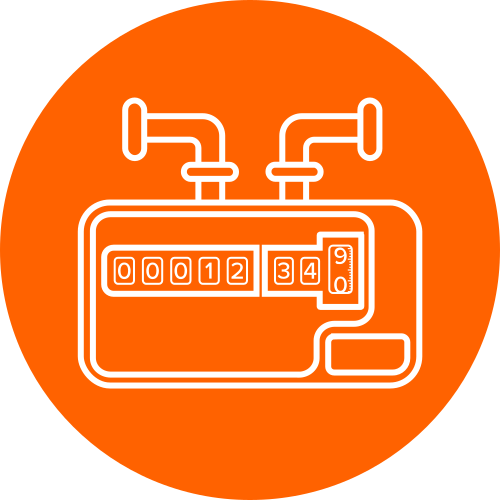
Metric gas meters record the amount of gas you’ve used in cubic meters (m³). You need to read them from left to right, including any zeros at the start, but skip any numbers in red or anything after a comma or decimal. If the dial is between two numbers, go for the lower one – unless it’s between nine and zero, then go with a nine.
Digital gas meters
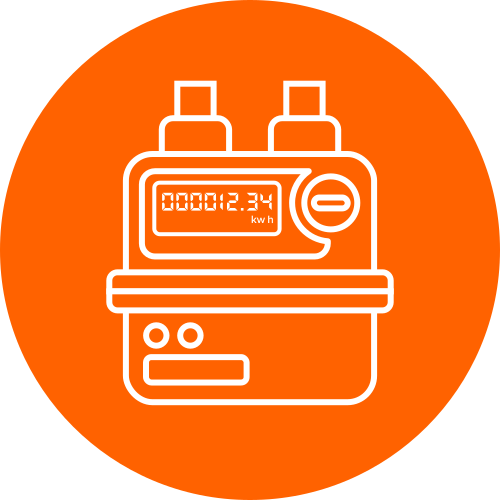
The process to read your digital gas meter follows the same rules as metric. The only difference is that you’ll need to press the red button to wake up your display screen. Then, you’ll need to write down all digits from left to right, excluding the last digit.

Imperial gas meter
Old-school imperial gas meters are being phased out, but some homes might still have them. Unlike digital and metric meters, imperial meters read your gas usage in cubic feet (ft³). Each dial turns the opposite way from the one next to it, so read carefully from left to right. If the pointer sits between two numbers, take the lower one (again, if it’s a decision between zero and nine, nine wins). If your meter has extra dials labelled ‘½’ or ‘2’, ignore them, since they aren’t used for meter readings.
How do I submit my meter reading?
If you want to submit your own reading, you can do so through your provider. Just jump onto your account online, navigate to ‘Submit a meter read’ (it will likely be in the ‘payment’ section), enter the numbers you’ve jotted down, and submit your reading. Double-check that the serial identification number matches what’s on your bill. You might also need to upload a photo of your meter. Then your provider will get to work processing it with your distributor before updating your account and sending out a revised bill.
If you’ve had more than one estimated bill in a row, your new reading might adjust your previous bills. This could be for up to four months in VIC, and nine months in NSW, ACT, QLD, and SA.
Time to start cooking with gas! Compare gas plans with iSelect
No one wants to be paying more than they need to for their gas bill thanks to estimated bills, but what about the actual price you’re paying for the gas? Comparing gas plans could help make sure yours still works for your household and your budget. Head online to iSelect’s comparison tool to browse from a range of energy plans and providers, or give us a call at 1800 664 532 to find out if your current gas plan still stacks up.
Get started on comparing energy plans today!
Save time and effort by comparing a range of energy plans with iSelect





iSelect does not compare all energy providers or plans in the market. The availability of plans may change from time to time, depending on who iSelect’s providers are and what plans they make available to iSelect. Not all plans made available from iSelect providers may be compared by iSelect either due to commercial arrangements, area or availability, so not all plans or providers compared by iSelect will be available to all customers. Some plans and special offers are available only from iSelect’s contact centre or website. Energy plans are available only for properties located in eligible areas of Victoria, New South Wales, South East Queensland, South Australia and ACT. Click here to view iSelect’s range of providers.