
.svg)


Understanding the Solar Sponge Tariff
Understanding the Solar Sponge Tariff





Written by
Rachel Gregg
Edited by
Andrew Kemp
Reviewed by
Julia PaszkaCompare Electricity & Gas Plans
Save time and effort by comparing a range of energy plans with iSelect



Long story short
A solar sponge tariff rewards consumption during peak solar power production
These tariffs encourage consumers to shape their power usage and capitalise on lower electricity rates when solar power supply is flooding the grid.
Solar sponge tariffs work like time-of-use plans
The difference is that instead of peak and off-peak, you also get a solar sponge period that makes using power during peak solar power (daylight) hours cheaper.
Anyone can benefit from a solar sponge tariff
You don’t need rooftop solar to have this tariff, just a smart meter. This means homes without solar panels can also jump on board.
What is the solar sponge tariff?
A solar sponge tariff is a type of time-of-use (ToU) tariff designed to encourage households to use more energy during the sunniest parts of the day when solar energy is plentiful. Think of it as shifting your demand to match the sun’s level, rather than leaving it to the usual evening peak. In July 2020, South Australia launched the country’s first solar sponge tariff. Since then, similar demand shaping models have been introduced in New South Wales, Queensland, Victoria, and the ACT.
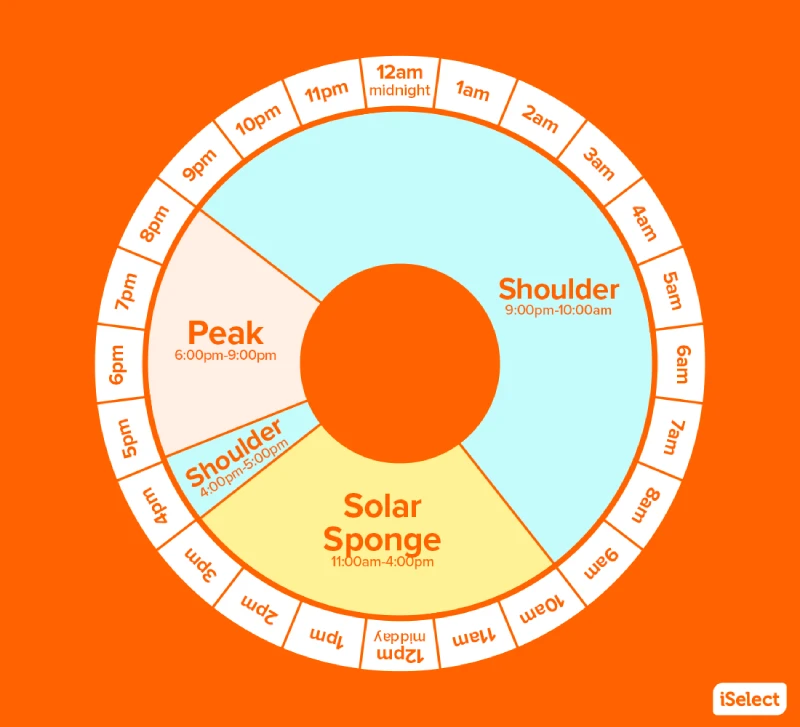
With millions of Australian homes exporting their renewable energy (in exchange for feed-in tariff credits), solar generation has started to overload electricity networks during daylight hours. Instead of letting that excess power go to waste (or cause bigger issues), a solar sponge rewards residential customers for using it.
The solar sponge tariff works to balance supply and demand through the addition of a ‘solar sponge’ window to the regular ToU model of peak and off-peak periods. During this window, electricity rates drop significantly in response to higher solar supply.
Let’s use South Australia as an example:
- Peak (5 pm-9 pm) rates are about $0.32 per kWh.
- Off-peak (9 pm-10 am and 4 pm-5 pm) rates are about $0.09 per kWh.
- Solar sponge (10 am-4 pm) rates are $0.03 per kWh.
This timetable encourages homes to turn on energy-hungry appliances during the brightest part of the day, lightening the load on the grid later. Making it a win-win for both parties.
The best part is that this electricity tariff isn’t just limited to solar-powered homes. As long as you’ve got a smart meter that records ToU information and live in an area with these tariffs, then you can take advantage of the solar sponge. That means renters, apartment complexes, and low-income homes that couldn’t jump on solar before can now feel some of the benefits.
 Helpful tip

Timing is everything when it comes to solar sponge tariffs. If you can set appliances on timers or smart controls so they run during solar sponge periods, you’re more likely to see the difference in your usage costs. You might not be able to avoid peak-hour usage altogether, but shifting even a portion of your usual nighttime activity can make a noticeable difference over time.
Julia Paszka
General Manager – Utilities
How can solar sponge tariffs help me save on energy costs?
Solar sponge tariffs can help you save, with some daytime electricity rates dropping to around 25% of the usual network tariff. That means you might pay a fraction of the normal cost during these hours of solar power.
Let’s use our fictional friend Tom in South Australia as an example. Tom and his partner use 12 kWh of electricity a day in their home. About 4kWh is used in off-peak daylight hours, 6kWh after work when demand spikes and the other 2kWh for baseline usage (this is for appliances that run all day and night like fridges). With the 2025-26 DMO flat rate pricing, this would cost him about $6.90 per day. But if he was on a solar sponge tariff (and shifted 1.5kW of his peak usage over to cheaper solar sponge hours), his daily bill could fall to $4.35.
Pros and cons of solar sponge tariffs

Pros
- Help stabilise the main grid by using excess solar power
- Low midday rates can help lower energy bills
- Can be used by all homes as long as they have a smart meter
- Affordable alternative for high-energy-use applications like electric vehicle charging
- Supports solar exports and renewable electricity generation

Cons
- You need to shift energy consumption into shorter off-peak windows or risk paying more
- Could need a new smart meter installed for the tariff
- Without smart appliances, it’s difficult to get the most from a solar sponge tariff
Tips to maximise the solar sponge
Run high-energy appliances during solar sponge times
Where possible, try to run appliances like hot water heaters, washing machines, heating, air conditioners, dryers, dishwashers, and EV chargers during these cheaper solar sponge hours for a lower running cost. Using timers, delay start settings, or connected apps can help make this easier and improve your energy efficiency.
Focus on the solar sponge rates
When comparing, it’s easy to get spooked by higher peak prices. But if most of your usage lands in the solar sponge or off-peak periods, peak hours shouldn’t be too much of a concern since they’ll only make up a small slice of your bills. The key is to understand your usage before signing up.
Bring your solar battery into the mix
If you aren’t home during solar sponge periods but still want to benefit, a solar home battery can spend these hours charging up so you can use that stored power later in the night when peak hour rates kick in. That way you’re avoiding higher peak rates as much as possible without being stuck at home all day.
How do I access the solar sponge tariff?
To access the solar sponge tariff, you’ll need to make sure it’s offered in your area. Then you’ll need to make sure your home has a smart meter that’s able to track your energy usage in smaller increments. If you’ve got solar, then you should already have a smart meter installed, which will measure usage every 30 minutes. If you want to jump over to the solar sponge tariff, this could mean a meter update before anything.
Once that’s sorted, contact your energy provider to see if they offer a solar sponge tariff or compare to see what other providers in your area can offer.
Find a solar plan that works for you
Whether you’ve got solar panels, are thinking about adding a battery, or don’t have solar at all, comparing energy plans can see whether a time-of-use tariff – like a solar sponge plan – could work for your home. With iSelect, you can compare a range of energy plans and providers online to find one that fits your usage habits. Explore online or call our energy comparison experts on 1800 664 532 for more help.
Get started on comparing energy plans today!
Save time and effort by comparing a range of energy plans with iSelect





iSelect does not compare all energy providers or plans in the market. The availability of plans may change from time to time, depending on who iSelect’s providers are and what plans they make available to iSelect. Not all plans made available from iSelect providers may be compared by iSelect either due to commercial arrangements, area or availability, so not all plans or providers compared by iSelect will be available to all customers. Some plans and special offers are available only from iSelect’s contact centre or website. Energy plans are available only for properties located in eligible areas of Victoria, New South Wales, South East Queensland, South Australia and ACT. Click here to view iSelect’s range of providers.