
.svg)

Not-at-Fault Claim
Not-at-Fault Claim




Written by
Kervin Mathew
Edited by
Ellie Garran
Reviewed by
Adrian BennettCompare car insurance policies the easy way
Save time and effort by comparing a range of car insurance quotes with iSelect



Long story short
In a not-at-fault car accident, the other driver is responsible for your costs
They are liable to cover your car’s repairs, towing and a hire car.
If the at-fault driver is uninsured, they’re still liable
Your insurer can liaise with them to arrange payment for the repairs.
If you can’t identify the driver, you might need to claim on your own policy
This might mean paying an excess.
What is a not-at-fault car insurance claim?
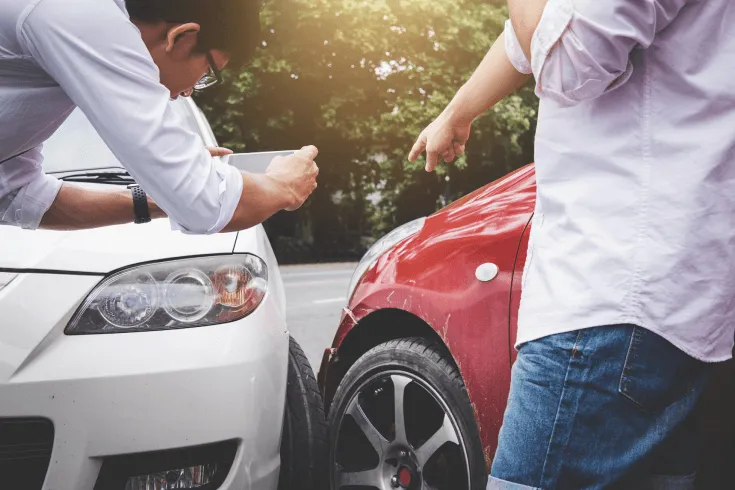
If you’re involved in an accident with another driver and you’re not the one who’s responsible for causing the accident, you’re known as the not-at-fault driver.
In such a scenario, the liability falls completely on the ‘at-fault’ driver. If they have car insurance, you can claim costs related to your car’s repairs, a hire car, or towing through their insurer. This is a not-at-fault claim.
Of course, insurers are entitled to investigate and determine who the at-fault driver is. That’s why it’s important that you gather as much evidence as possible to prove you’re not at fault. If you can’t provide enough proof, you might have to dip into your own comprehensive car insurance and split the repair bill.
What should I do after a not-at-fault accident?
A car accident can be a jarring experience. If it does happen to you, it’s important that you try to gather your thoughts and remain calm – so you can focus on the next crucial steps.
Keep safety top of mind
Everyone’s safety is paramount. You’ll need to call 000 if someone is injured, if the accident is severe and disrupting traffic, or if the other driver refuses to cooperate. You can also try and move your car to a safer spot if it doesn’t come in the way of gathering evidence.
Collect evidence and at-fault driver details
Whether you’re going down the insurance route or not, you’ll want to collect the other driver’s information, such as their:
- name, address and contact details
- licence number and state of issue
- insurance provider and policy details
- vehicle’s registration, make and model.
Also, make a note of the date, time and location of the accident. You could also approach potential witnesses for their contact information and any details they may have noticed about the accident. And if it’s safe enough, try and take photos of the accident scene and the extent of the damage. It certainly helps to have all your bases covered when it’s time to make a claim.
Get a tow
After you’ve sorted out insurance details and evidence, it’s time to get moving. If your car is undrivable and needs a tow, it’s on the at-fault driver and their insurer to pay for a tow service to be sent out. Remember, your state or territory may have towing rights where you get to decide who tows your car and where it’s towed.1For more information, see Government of Western Australia – Towing after an accident
How do I make an insurance claim for a not-at-fault accident?
Let’s start with something reassuring. Generally, your insurer will take on the task of working with the other driver’s insurer and settling your not-at-fault claim – which is certainly one of the benefits of being backed by a car insurance policy! With that silver lining in mind, here’s how you can make an insurance claim for a not-at-fault accident.
Do I need to pay an excess if I claim for a not-at-fault accident?
Generally, no. You won’t have to pay a car insurance excess if the other driver is at fault, has car insurance, and has cooperated with you every step of the way like a saint!
Unfortunately, some not-at-fault accidents don’t play out the way they should – that is, if the at-fault driver refuses to cooperate or flees the scene.
If that happens, you may have to lodge a claim with your own insurer. When you do, you could face a premium increase, or your no-claim discount could take a hit even if you’re the not-at-fault driver.
 Helpful tip

If you find yourself in a bingle with another driver, you don’t have to admit that you’re the driver at fault – even if you think you are! Your safety and collecting evidence to send to your insurer is your priority. However, if the evidence points to you as the driver at fault, a comprehensive policy is your best bet to recovering from the damage caused by the accident – whether it’s restoring your own car or the other party’s car – without worrying about the potentially massive repair bill.
Adrian Bennett
General Manager for General Insurance
Frequently asked questions
What should I do if the accident involves an unidentified driver?
If the at-fault driver flees the scene, say if they clip your front bumper out of nowhere and then speed away like nothing happened, you could certainly call them a lot of things! But let’s call them the ‘unidentified driver’ for now.
In such an instance, you should try your best to collect information that can help identify the driver at fault. Try to note the make, model and registration of their car. This will be important if you decide to file a report with the police – which is well within your legal rights.2For more information, see Victoria Legal Aid – Leaving the scene of a vehicle accident
Then, get in touch with your insurer and give them all the information you have that’s relevant to the incident. If your insurer can identify the driver at fault, you might not need to pay an excess.
Unfortunately, if you’re not able to provide these details, you may decide to make a claim with your own insurer. And that might mean paying the applicable excess.
Is it worth making a claim for minor damage?
You may not want to get your insurers involved when it comes to repairing minor damage like a little scratch or a less-than-obvious dent. It wouldn’t make sense to pay an excess that costs as much as repairs for the damage itself.
Plus, any claim you make might impact future premiums and potentially any no-claim bonus.
Ultimately, you and the other driver, at your own discretion, can choose to work things out between yourselves – nice and easy. However, if you have even the slightest doubt about the at-fault driver following through, it’s recommended you get in touch with your insurer and keep them in the know.
What should I do if the other driver isn’t insured?
If the other driver is clearly at fault but uninsured, your insurer may still be able to cover repairs and other relevant costs. However, this will likely depend on what’s included in your car insurance policy.
For example, if you’re the not-at-fault driver and you have comprehensive car insurance, you might be able to claim damage to your car, towing costs or a hire car. You may not be able to claim damages done to your car if you only have third party cover.
Unfortunately, any claims you make with your own insurer may require you to pay an excess. Read through your policy’s product disclosure statement (PDS) to understand exactly how your insurer can cover you.
What if I’ve been injured in a not-at-fault accident?
If you’re injured in an accident, the at-fault driver’s compulsory third-party (CTP) insurance policy should be able to cover the costs of resulting medical expenses and rehabilitation, and loss of income, if any.
Unless you live in NSW, CTP is usually included in your car’s registration. And, as the name suggests, it’s compulsory across Australia. You can refer to your state or territory’s regulatory authority for more information on how you’re covered.
| State/Territory | Regulatory authority |
| Australian Capital Territory | Motor Accidents Injury (MAI) Scheme |
| New South Wales | State Insurance Regulatory Authority (SIRA) |
| Northern Territory | NT Motor Accidents Compensation Commission (MACC) |
| Queensland | Motor Accident Insurance Commission (MAIC) |
| South Australia | CTP Insurance Regulator |
| Tasmania | Motor Accidents Insurance Board (MAIB) |
| Victoria | Transport Accident Charge (TAC) |
| Western Australia | Insurance Commission of Western Australia (ICWA) |
How do I compare car insurance?
When you find yourself in the wrong place at the wrong time, it pays to have the right kind of car insurance backing you up. Use the iSelect car insurance comparison tool to browse through a range of car insurance policies from our providers and decide which one suits you best.
Get started on comparing car insurance policies!
Save time and effort by comparing a range of car insurance quotes with iSelect





iSelect General Pty Ltd (ABN 90 131 798 126. AFSL 334115) has partnered with Compare the Market (ABN 83 117 323 378. AFSL 422926) to compare a range of car insurers and policies. Not all providers in the market or all policies offered by the partners are compared and not all policies or special offers are available to all customers.
A number of our participating general insurance brands are arranged by Auto & General Services Pty Ltd ACN 003 617 909 on behalf of Auto & General Insurance Company Limited 111 586 353, both of which are related entities of iSelect Limited. Our relationship with those companies does not impact the integrity of our comparison service. Click here to view iSelect’s range of providers.
Any advice provided by iSelect is of a general nature and does not take into account your objectives, financial situation or needs. You need to consider the appropriateness of any information or general advice iSelect gives you, having regard to your personal situation, before acting on iSelect’s advice or purchasing any policy. You should consider iSelect’s Financial Services Guide which provides information about our services and your rights as a client of iSelect. iSelect receives commission for each policy sold that is a percentage of the premium or a flat fee. Ask us for more details before we provide you with any services.