
.svg)

What To Do if You’re Not at Fault and Don’t Have Car Insurance
What To Do if You’re Not at Fault and Don’t Have Car Insurance




Written by
Kervin Mathew
Edited by
Ellie Garran
Reviewed by
Adrian BennettCompare car insurance policies the easy way
Save time and effort by comparing a range of car insurance quotes with iSelect



Long story short
If you’re in a not-at-fault car accident and don’t have insurance, you may need to chase up the other driver for repairs
If both you and the at-fault driver have insurance, you can leave the paperwork to the insurers.
Repair costs after an accident can run into the thousands
The average car insurance claim payout was $5,202 in June 2024, up 42% since 2019.1Insurance Council of Australia – Motor Insurance Policy Paper: A Roadmap for Reducing Rising Premiums, p12
Legally, you only need compulsory third-party (CTP) insurance or a Green Slip to drive in Australia
CTP insurance covers personal injury and death. For damage to vehicles or property, you’ll need extra cover.
Comprehensive cover gives your car the best possible protection
It can cover damage from uninsured drivers and hit-and-runs, and can come with extras like a hire car.
Can I drive without car insurance in Australia?
You’re allowed to drive without comprehensive or third-party cover in Australia. But you’ll need compulsory third-party (CTP) insurance, or a Green Slip if you’re in NSW, to drive a motor vehicle on Australian roads legally.
CTP insurance can help cover medical and compensation costs if you cause an accident that leads to someone’s injury or death. If you want to be covered for property damage, though, you’ll have to consider higher levels of cover.
Without comprehensive insurance or third-party property cover, if you damage someone else’s car or property, you’ll need to pay for their repairs out of pocket. Depending on the scale and nature of the accident, repair costs could easily run into the thousands.

The average payout for motor insurance claims in June 2024 was $5,202. That’s 42% higher than it was in 2019 – double the rate of inflation over the same period.
What happens if I don’t have car insurance and someone hits my car?
Let’s consider a fictional scenario where Dax, an uninsured driver, encounters his first accident. Luckily for him, he’s not the one who caused it.
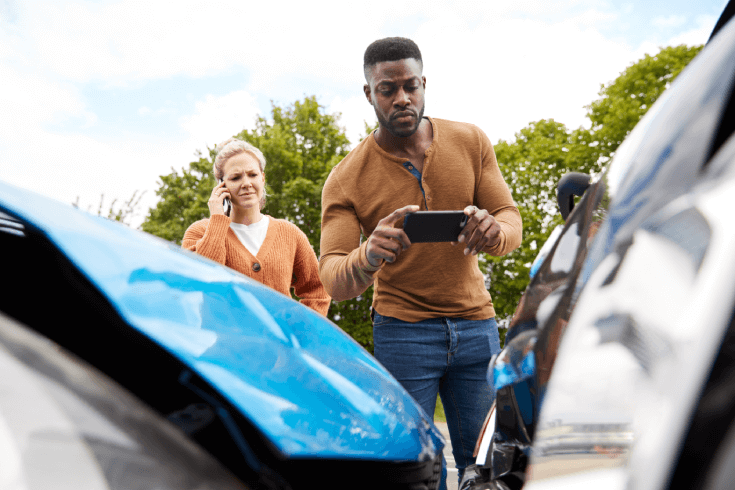
Dax is cruising along his local shopping strip when someone on a side road merges carelessly and slams into his car. The damage is serious enough to put Dax a few thousand behind in repair costs.

Shaking off the initial shock, Dax checks whether he or anyone else has been hurt. Everyone’s OK – phew! If someone had needed immediate medical attention or the crash had caused a traffic hazard, he would’ve had to dial 000 for help.

Major crisis avoided (mostly), Dax can’t help but think about the money he’ll have to spend on repairs. He then vaguely remembers something similar that happened to a friend and springs into action.

Dax asks the driver at fault if they’re willing to share details such their licence number, rego and insurance details, if they’re insured. Thankfully, the driver cooperates. If the driver had refused to cooperate, Dax could’ve called the police.

Dax also whips out his phone and takes photos of the damage for evidence. He also checks with witnesses for their account of things and asks for their contact information.
By following these steps, Dax has set himself up to deal with the aftermath of a not-at-fault accident. This is super important, as what follows could go one of many ways.
Who pays for the damage?
Generally, the driver who caused the accident pays for any damage they cause to your car. If the driver at fault is insured, they can pay for the damages through their insurer. Sometimes, the fault falls on both drivers, in which case, both parties can mutually agree on who pays for what.
What if the at-fault driver isn’t insured?
If the driver at fault isn’t insured, they’re legally obligated to pay out of pocket for repairs to your car. Of course, the at-fault driver may not want to cooperate – in which case, you can call the police and seek legal advice.
What if I’m injured in a not-at-fault accident?
Of course, there’s always the chance of an injury in a collision. If you’re injured, you should call the police to the scene if you can.
In such a situation, compulsory third-party (CTP) insurance kicks in. Typically, the other driver’s CTP insurance will help cover any of your medical or compensation costs, such as hospital bills or loss of income.
 Helpful tip

While CTP is the bare minimum to drive legally in Australia, third-party property or, better yet, comprehensive cover comes with some handy benefits. Say, you’re in a not-at-fault accident and the other driver agrees to pay for your repairs through their insurer. If you have insurance, you won’t need to chase down the at-fault driver for updates. Instead, just share their policy number with your insurer, and they’ll take care of the rest.
Adrian Bennett
General Manager for General Insurance
What kind of car insurance do I need if I’m in a not-at-fault accident?
In a perfect world, we’d all be getting enough sleep, and you wouldn’t need car insurance if you were faultless in an accident.
But consider this: a driver who’s damaged your car may not have the right kind of insurance (nor the intention) to cover your repair costs. Worse still if it’s a hit-and-run and you’re left with nothing but a banged-up vehicle and your faith in humanity at an all-time low!
Best to be prepared with the right kind of cover. Here’s how the different types of cover will work if you’re in a not-at-fault accident.
Third-party property
Third-party property car insurance helps cover the cost of repairs for any damage you cause to someone else’s car or property. But it won’t pay for repairs to your own car, should you get stuck with the bill.
Third-party property, fire, and theft
A third-party property, fire, and theft car insurance policy will cover your car if it’s damaged by a fire or stolen and not recovered. But it won’t cover any damage to your car from an accident, even if you’re not at fault and the other driver doesn’t have car insurance.
Comprehensive cover
Comprehensive car insurance is the ultimate safeguard against nearly any kind of motoring mishap. It’s built to cover accidental damage to your car, including when it’s caused by an unidentified driver. You even might get access to handy optional extras like a hire car, your choice of repairer, and zero-excess windscreen cover to help get you back behind the wheel with little to no dramas.
Get the backing of solid car insurance
A not-at-fault accident can happen out of nowhere. So, why add to the uncertainty of it all hoping that the other driver’s insurance will take care of things? Instead, compare insurance quotes from our range of providers and sign yourself up for a policy that helps put the odds in your favour.
Get started on comparing car insurance policies!
Save time and effort by comparing a range of car insurance quotes with iSelect





iSelect General Pty Ltd (ABN 90 131 798 126. AFSL 334115) has partnered with Compare the Market (ABN 83 117 323 378. AFSL 422926) to compare a range of car insurers and policies. Not all providers in the market or all policies offered by the partners are compared and not all policies or special offers are available to all customers.
A number of our participating general insurance brands are arranged by Auto & General Services Pty Ltd ACN 003 617 909 on behalf of Auto & General Insurance Company Limited 111 586 353, both of which are related entities of iSelect Limited. Our relationship with those companies does not impact the integrity of our comparison service. Click here to view iSelect’s range of providers.
Any advice provided by iSelect is of a general nature and does not take into account your objectives, financial situation or needs. You need to consider the appropriateness of any information or general advice iSelect gives you, having regard to your personal situation, before acting on iSelect’s advice or purchasing any policy. You should consider iSelect’s Financial Services Guide which provides information about our services and your rights as a client of iSelect. iSelect receives commission for each policy sold that is a percentage of the premium or a flat fee. Ask us for more details before we provide you with any services.