
.svg)

Travel Insurance Philippines
Travel Insurance Philippines



Written by
Rachel Gregg
Edited by
Laura CrowdenEasily compare Travel Insurance
Save time and effort by comparing a range of travel insurance policies with iSelect

Do I need travel insurance for my trip to the Philippines?

Long story short
Not all activities are covered by default
Planning to dive, snorkel, or explore caves? You’ll need to make sure those are included in your policy since some activities might only be covered under comprehensive plans or optional extras.
Travel insurance is a small cost for peace of mind on your trip
Travel insurance for your trip to the Philippines can start at about $30 for basic coverage and be around $80 for more comprehensive policies. But the exact price will depend on your needs and trip details.
Crime and safety risks are real
Petty theft, drink spiking, and even kidnapping in the southern areas of the Philippines are a real safety risk for travellers. Insurance won’t stop it, but it can help if things go sideways.
Do I need travel insurance for my trip to the Philippines?
Technically no – there is no requirement to have travel insurance to enter the Philippines. But travel insurance is like packing eight pairs of underwear for a four-day trip. You’re probably not going to need those extra four pairs (fingers crossed), but just knowing they’re there? Pure peace of mind.
It’s the same with travel insurance. No one wants to use it, but if something goes wrong, it could save you your tropical escape from turning into your wallet’s worst nightmare. Your coverage (and costs) will differ depending on whether the Philippines is your only stop or just one of many, how long you’re away, and what type of trip you’re planning. But you can find coverage for most common holiday activities like hiking, or sailing tours, coverage for your luggage and protection for any natural disaster that might challenge your Philippines trip.
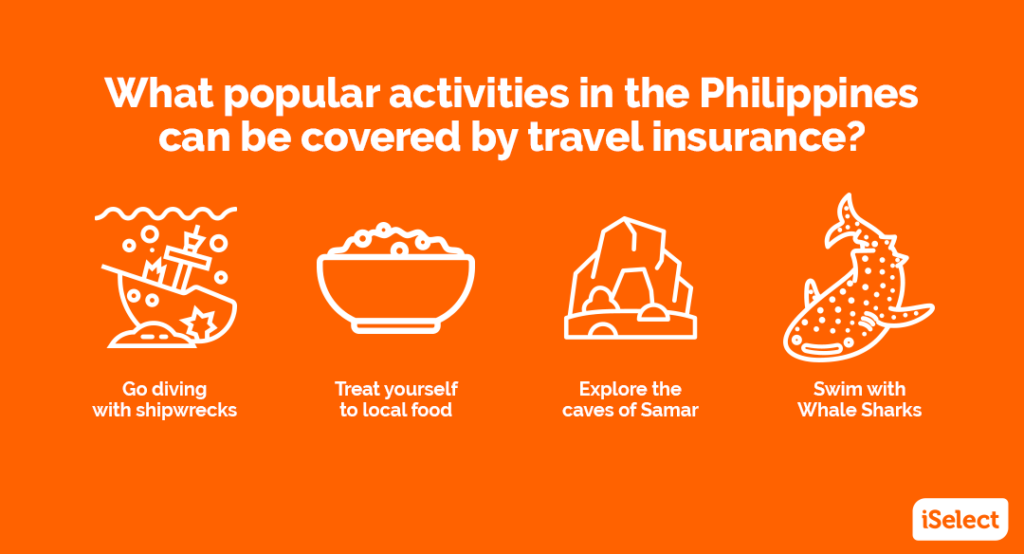
What popular activities in the Philippines can be covered by travel insurance?
Home to stunning beaches, tropical islands, and warm hospitality, the Philippines can offer a mix of lively cities and isolated islands within its 7,600-strong island chain. Whether you’re staying in the Pearl of the Orient (otherwise known as Manila) or sailing out to El Nido for some island hopping, here are some popular activities that your policy could cover.
Dive amongst WWII-era shipwrecks
If shipwrecks are your thing, Coron (near El Nido) delivers. With 11 sunken warships just below the surface, and more to be found deeper below, some shipwrecks are even visible to snorkellers, making it an attraction all skill levels can enjoy. If you want to do some more snorkelling nearby a 45-minute boat ride will take you to Culion, filled with secluded beaches and preserved snorkelling sites. Just make sure that diving’s included in your travel insurance policy before wrangling yourself into your wetsuit.
Take your tastebuds on a trip in Iloilo
UNESCO didn’t name Iloilo a Creative City of Gastronomy for nothing. This is the place to stop if you want to try some delicacies of Filipino culture. Think steaming bowls of pancit Molo (soup dumpling dish) and jam-packed siopao (stuffed steamed bun with Chinese sausage, egg, bacon, and pork). But in case your stomach can’t take the heat of these local delights, travel insurance will have you covered for any unplanned medical expenses.
Explore the underground cave systems in Samar
Samar’s cave systems are nature’s underground cathedrals. With caverns the size of football fields and trickling in the dark, it’s a sight to be seen. At Samar, you can visit Sohoton Cave with its cathedral-like dome and stone bridge, or crawl through the longest cave in the Philippines in the Gobingob Caves. If you love seeing the glittering shine of calcite or standing next to stalagmites as tall as you, make sure to add this to your list. Just make sure your policy covers you for riskier adrenaline-filled activities, or if you need some extra coverage.
Swim with majestic whale sharks in Cebu.
The Philippines offers some of the best waters for whale sharks (known as butanding to Filipinos), and there are several swimming spots across the archipelago with these deep-sea giants. Whale Shark season is usually from November to June, with a high number of whale sharks passing through the Philippines’ tropical waters in the first half of the year. Known as the gentle giants of the sea, swimming with whale sharks is a truly humbling experience that’ll leave you in awe. Just make sure your policy will cover you for medical injuries in case you get a little too close to these spotty giants.
What health and safety risks should I consider when travelling to the Philippines?

Kidnapping
As of April 2025, the southern areas of the Philippines, like the Sulu archipelago and western Mindanao, aren’t recommended for tourists, due to the high threat of kidnapping and piracy in the area.1For more information see Smartraveller – Philippines If you must travel to these areas, don’t travel by boat and stay somewhere with tight security measures in place.

Natural disasters
With severe weather events like typhoons (from May to December), volcanic eruptions, earthquakes, and tsunamis, all thanks to the country’s location on the Ring of Fire, it’s a place often exposed to extreme weather. The country has four distinct climate zones, with a severe wet season from July to September in Manila, so you need to plan your trip and pack accordingly for each area you’ll be visiting.

Crime
Crimes, like robbery, pickpocketing, and bag snatching, are common in the Philippines. Stay alert in metro areas like shopping malls, nightclubs, and busy streets. Drink spiking and methanol poisoning are also common in areas of Manila frequented by foreigners. Make sure to never leave drinks unattended and get immediate medical care if you think you or someone else has been drugged.

Health risks
Rabies (spread through animals), malaria, dengue, Japanese encephalitis, and filariasis (insect-borne) all pose a risk on your trip to the Philippines. Make sure to use insect repellent, avoid close contact with animals, and talk to your doctor about recommended vaccines when planning your Philippines trip.

‘El Nido was definitely my favourite spot. If you’re heading there, make sure to get your diving ticket before you go so you can explore all the shipwrecks around the islands. The snorkelling’s great, but diving gets you up close. Also, make sure to pack some muesli bars or other snacks, the food can be average.‘
Adrian Bennett
General Manager, General Insurance
What does travel insurance to the Philippines include?
Most travel insurance policies will include a few general items; just make sure to check exactly what’s included in your policy before catching your flight. Generally, most policies will cover:
- medical expenses (including medical evacuation expenses)
- most low-risk activities (some insurers include activities like cycling or snorkelling – just make sure to check with your specific plan)
- luggage and personal items (whether these get lost in transit by your airline or are stolen)
- flight delays or cancellations (just make sure to have hard evidence for these changes to your travel)
- lost or stolen money
What does travel insurance to the Philippines not include?
You’ll probably find that the big things not covered by your policy will generally be similar from one provider to another. These can often include:
- travelling against government advice
- high-risk activities (like diving with an unqualified instructor)
- trip cancellation for personal reasons, or just cause you changed your mind about your holiday.
- luggage and personal items stolen after being left in a public space
- partaking in reckless activity or acting in an irresponsible way (like excessive drinking)
How much does travel insurance to the Philippines cost?
Travel insurance for the Philippines can be a little extra expense that can make the difference between a good and a great holiday. Basic policies for the Philippines can range from around $35 to $60+ a day. When looking at a more comprehensive policy, you can expect to look at prices at about $80 or more, but again, can vary quite a bit between providers which is why it pays to shop around.
Enjoy sun, sand, and peace of mind with travel insurance for the Philippines
Whether you’re cruising down a river cave in Palawan, navigating your way through the streets of Cebu or chasing waterfalls like it’s your 9-to-5, travel insurance lets you explore without sweating the what-ifs. Use iSelect’s online comparison tool to browse from a range of policies and providers to find the best match for your Philippines trip.
Easily compare Travel insurance quotes
Save time and effort by comparing a range of travel insurance policies with iSelect
iSelect does not compare all travel insurers or policies in the market. Travel insurance is only available through our website and not all policies are available at all times or in all areas. Not all policies available from our partners are compared by iSelect and due to commercial arrangements and customer circumstances not all policies compared by iSelect will be available to all customers. Click here to view iSelect’s range of providers.
iSelect General Pty Limited ABN 90 131 798 126, AFS Licence Number: 334115. Any advice provided by iSelect is of a general nature and does not take into account your objectives, financial situation or needs. You need to consider the appropriateness of any information or general advice iSelect gives you, having regard to your personal situation, before acting on iSelect’s advice or purchasing any policy. You should consider iSelect’s Financial Services Guide which provides information about our services and your rights as a client of iSelect. iSelect receives commission for each policy sold.