
.svg)

Home insurance for granny flats and sheds
Home insurance for granny flats and sheds




Written by
Tina Sendin
Edited by
Ellie Garran
Reviewed by
Adrian BennettCompare home and contents insurance the easy way
Save time and effort by comparing a range of home and contents insurance policies with iSelect

What’s a granny flat?

Long story short
Granny flats are more than just homes for Nan
They’re self-contained spaces that can be used for family, rentals, offices or guest housing.
Sheds can be versatile, not just for storage
From gyms to creative studios, sheds might house your weight rack, power tools and lots more.
Insurance rules depend on how you use the space
Renting it out? Using it for a business? Standard home insurance might not be enough.
Almost 2% of Aussie homes faced break-ins in 2024–25
Bikes, tools and gear are often targets. Home insurance can help protect the valuables in your granny flat and shed.
What’s a granny flat?
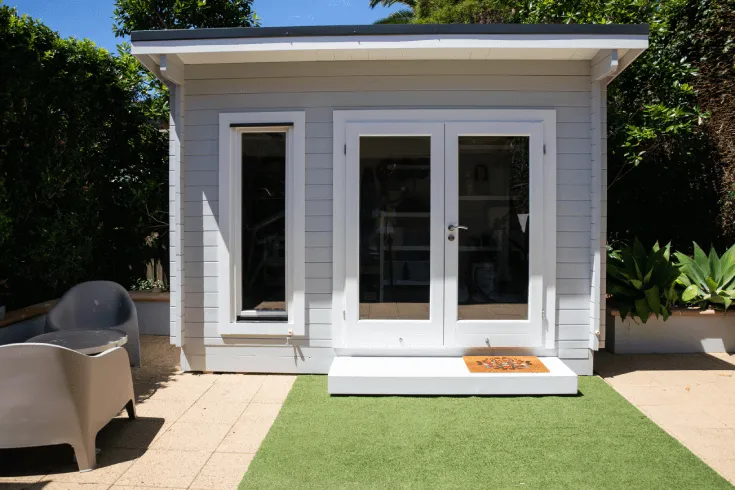
A granny flat is a smaller second home built on the same block as your main house. It’s typically used as a secondary dwelling – like a guest house, rental or home office. And don’t forget the old-school way of using it, when Nan and Pa would use granny flats to stay close to family (and, of course, the grandkids) while still having their own space.
It’s not just your typical garden shed – think of it as a tiny home that has the following characteristics:
- A self-contained set-up: a granny flat is typically kitted out with amenities like a kitchen, bathroom and a living area.
- Detached or attached: it can either sit separate from your main house or be connected to it.
- A size limit: councils often cap it at around 60 square metres.
Granny flats are a great way to get more out of your space, possibly bring in a bit of extra cash or adapt to the changing needs of your family (like when your teenager decides to try living on their own – sort of).
What’s a shed?
A shed is a structure that’s separate to your home but situated in the same property, which is commonly used as a storage space, workspace, business site, man cave/she shed or home gym. It usually doesn’t have amenities and is usually more low-key than a granny flat.
A shed could be used as:
- a storage space for tools, bikes or camping gear
- a workspace for hobbies like woodworking, pottery, crafting or repairs
- a business site, like a studio office or creative space
- a home gym, or where you keep that Peloton bike you bought during lockdown.
Sheds vary in size and sophistication – from basic metal storage units to a dream room complete with fancy furniture, insulation and power.
Does home insurance cover granny flats and sheds?
Yes, most home insurance policies can cover granny flats and sheds. It’s not always straightforward, though, as some policies have limitations around how you use it – say if you’re renting it out or using it for business.
To make sure your granny flat and shed are adequately covered, it’s worth reading the relevant product disclosure statement (PDS).
Now, if you’re trying to look for ‘granny flats’ or ‘sheds’ in your PDS, don’t stress if you can’t find them. They’re usually tucked under ‘fixed structure’ or ‘domestic outbuildings’.
Let’s look at what’s often covered and not covered in a standard home insurance policy.
 Helpful tip

If you’re scratching your head wondering whether your granny flat is covered, it’s definitely worth giving your product disclosure statement a squiz. A lot of policies have pretty strict rules, and plenty of them won’t cover anything that hasn’t been properly converted and approved as a ‘domestic dwelling’. So, it pays to double-check where you stand and avoid paying out of pocket if something goes wrong. Better safe than sorry, right?
Adrian Bennett
General Manager for General Insurance
What types of insurance can I get for my granny flat or shed?
Assuming your granny flat or shed has the same address as your main property, you could get it covered through building insurance for the structure, contents insurance for the things inside, or combined home and contents insurance for both. If you’re renting it out, landlord insurance might apply, or if you’re storing valuables there, you can insure them with personal effects cover.

Building insurance
This covers the structure of your home – the four walls, the roof and anything else that doesn’t fall out if you flip the house upside down. Any fixtures and fittings – including a built-in dishwasher, oven, showers, taps and light fittings – all come under this type of cover.
If your granny flat or shed is more on the minimalist side, then building insurance could be the cover it needs against insured events, like fire, theft and vandalism.

Contents insurance
Contents insurance covers things that make your house a home. If your granny flat or shed is packed with pricey gear or stuff you really care about – like your Peloton bike that’s still getting a good workout every week – contents insurance can help keep it all safe. That way, if something goes wrong (like someone helping themselves to your mancave’s TV), you don’t have to foot the bill to get things back to normal.
Contents insurance is also great if you’re living in someone else’s granny flat and want to make sure your stuff is covered.

Combined home and contents insurance
This is the full package, where your building and contents are covered under one combined policy. It’s handy if you want to cover everything – from the structures to everything inside.
Combined home and contents insurance policies are often easier to manage because you’re dealing with one insurer for both types of cover. They could also save you a few bucks when bundled together.

Landlord insurance
If you’re renting out your granny flat on Airbnb or to long-term tenants, landlord insurance could be a smart idea. This optional cover takes care of tenant-related dramas like unpaid rent or damage caused by renters, which your standard building insurance or combined home and contents policy might not.
Once you start renting out your granny flat, insurers will see it as an investment property, not an owner-occupied home. That means it won’t be covered by standard home insurance. So having landlord insurance as extra protection could save you from big headaches down the track.

Personal effects cover
Personal effects cover is an optional add-on to your standard home insurance. It’s perfect if you’ve got high-value items stored in your shed or granny flat.
Whether it’s your collection of power tools, camping gear or sports equipment, personal effects cover ensures those specific items are covered. It’s an important extra layer of protection, especially if you’ve invested a lot in high-quality gear that’s stored away from the main house.
Now let’s have a look at some fictional scenarios and see which types of insurance could apply for each.
 Your teenager decides to try their hand at ‘adulting’.
Building insurance or combined home and contents insurance if you have prized possessions inside
 A mate’s staying in your fully furnished granny flat.
Combined home and contents policy
 You’re renting out your granny flat indefinitely.
Landlord insurance
 You’re renting out your main house for tenant A and your granny flat for tenant B.
Two separate landlord insurance policies
 You live in the main property and you’re renting out your granny flat for long-term lease.
Landlord insurance for the granny flat
Standard building insurance, contents insurance or both for the main house
 You’re planning to list your granny flat on Airbnb.
Specialised insurers that cover short-term rentals
Why would I need insurance for my granny flat or shed?
One reason for getting granny flat insurance is the high cost of rebuilding the granny flat or shed. Plus, given that almost 2% of Australian households experienced break-ins in 2024–25, it’s worth considering getting home insurance to protect some of the commonly stolen items that sit in sheds.1Australian Bureau of Statistics – Crime Victimisation And if you’re renting out your granny flat, then having a safety net for your income and legal liability could be reason enough to consider getting coverage for these fixed structures.
Let’s dive deeper into these reasons:
- High replacement costs: Rebuilding a burnt-out or storm-damaged shed isn’t cheap. Storage shed insurance cushions the blow, saving your wallet from a big hit when things go pear-shaped.
- Theft protection: In 2024–25, some of the more common items stolen in Australia include bicycles, sporting equipment and tools – stuff that’s usually stored in sheds.2Australian Bureau of Statistics – Crime Victimisation And with almost 2% of Aussie households dealing with break-ins (that’s 196,600 to be exact),3Australian Bureau of Statistics – Crime Victimisation shed insurance can help you avoid footing the entire replacement bill if someone decides to walk off with your possessions.
- Rental income safety: If you’re renting out your granny flat, the income it generates is worth protecting. Landlord insurance has your back if your tenants bail without paying or if damage to the flat means it’s off the market for a bit.
- Liability: Here’s one that many people don’t think about – what if a tenant cops an injury while renting your granny flat? Without landlord insurance, you could be left wide open to a liability claim, footing the bill for their medical expenses or legal fees. That’s enough to put a serious dent in the savings you’ve been stashing for next year’s European summer getaway.
My granny flat is a long-term rental. What type of home insurance can I get to cover it?
You might want to consider add-on landlord insurance to be properly covered as insurance companies tend to see the property as an investment once you start making money from it. Sorry – your standard home insurance probably won’t cut it.
Landlord insurance is an optional add-on that can cover you for stuff like:
- rent loss if tenants leave without paying or the flat’s too damaged to rent out
- damage tenants leave behind, whether it’s accidental or something worse
- liability claims if someone’s hurt on the property.
It’s a good idea to give your insurer a call. Some insurance providers will explicitly cover granny flat rentals through landlord insurance but not with a standard home and contents policy. It makes sense to ensure you’ve got the right cover in place.
I’m living in a rented granny flat. What type of home insurance can I get?
If you’re renting a granny flat, contents insurance could help make sure your stuff (think electronics, furniture and jewellery) is protected from a tree falling over your flat, pesky neighbourhood burglars or that odd earthquake. The good news? You don’t have to stress about getting protection for the granny flat itself; it’s your landlord’s job to get building or landlord insurance.
Where can I find and compare home insurance for my granny flat and shed?
iSelect makes it easy to compare home insurance options without the hassle. No need to juggle dozens of tabs or risk freezing your laptop. With the iSelect comparison tool, you can check out a range of policies side by side – all in a few clicks. Start comparing home insurance today!
Get started on comparing home and contents today!
Save time and effort by comparing a range of home and contents insurance policies with iSelect
iSelect General Pty Ltd (ABN 90 131 798 126. AFSL 334115) has partnered with Compare the Market (ABN 83 117 323 378. AFSL 422926) to compare a range of home insurers and policies. Not all providers in the market or all policies offered by the partners are compared and not all policies or special offers are available to all customers.
A number of our participating general insurance brands are arranged by Auto & General Services Pty Ltd ACN 003 617 909 on behalf of Auto & General Insurance Company Limited 111 586 353, both of which are related entities of iSelect Limited. Our relationship with those companies does not impact the integrity of our comparison service. Click here to view iSelect’s range of providers.
Any advice provided by iSelect is of a general nature and does not take into account your objectives, financial situation or needs. You need to consider the appropriateness of any information or general advice iSelect gives you, having regard to your personal situation, before acting on iSelect’s advice or purchasing any policy. You should consider iSelect’s Financial Services Guide which provides information about our services and your rights as a client of iSelect. iSelect receives commission for each policy sold that is a percentage of the premium or a flat fee. Ask us for more details before we provide you with any services.