
.svg)


How to Read Your Electricity Bill
How to Read Your Electricity Bill





Written by
Rachel Gregg
Edited by
Ellie Garran
Reviewed by
Julia PaszkaCompare Electricity & Gas Plans
Save time and effort by comparing a range of energy plans with iSelect



Long story short
Your electricity bill shows more than the amount due
It includes your account details, plan type, usage charges, supply fees, meter readings, and any discounts or concessions applied, which can all play into your final bill price.
Tariff types can affect your electricity costs
Time-of-use tariffs, flat rates, and controlled-load tariffs all charge in different ways. Understanding your tariff can help you use your energy in the best way and help you compare.
Climate and solar make a big difference to your bill
Weather changes across the country and the seasons, and so does the energy you need. Also, solar and feed-in tariffs can cause your bills to vary, even if your plan stays the same.
Why is it important to understand my electricity bill?
Let’s be honest, your electricity bill isn’t the most thrilling read out there. But understanding more than just the price and due date on your bills can be a pretty powerful tool. From kWhs to supply charges, your bill is packed with info that actually matters (unlike that fridge your partner swore you needed because it has a TV in the door).
Getting your head around those details doesn’t just help you avoid any surprises; it also makes comparing a lot easier. It’s like doing your research before buying a new car. You know what your mileage is like, how much boot space you need, and whether heated seats are a must before handing over your cash. When it comes to electricity bills, understanding what drives your costs, what a kWh costs you, where the majority of your usage falls, and what tariffs work for your household can all help – and all of this can be found out on your regular electricity bill. Understanding what’s on your power bill helps you make smarter energy choices (without all the guesswork).
What factors affect my electricity bill?

Climate
It makes sense that your energy use depends on the weather around you. A home in Victoria, for example, will likely have a bigger heating bill in the frosty winter than someone in Northern NSW, where it’s practically summer all year round. So, when comparing with other electricity bills, take them with a grain of salt and think about the weather’s impact on your area.

Types of tariffs
The type of tariff you’re on can play big time in your final energy bill. It’s worth checking how yours stacks up by comparing a few old bills. Time-of-use tariffs, for example, can be great for people who can shift their energy usage to off-peak times, but not so great if you need to run the heater or dishwasher during the most expensive hours. Make sure to get a good grasp of the tariff you’re on and whether it suits your home and budget.
Solar
If you’ve got solar panels, your bills might be a lot smaller than other homes (lucky you). But just because you’re powering a majority of your home with the sun’s rays doesn’t mean you can hop off the electricity train just yet. You’ll likely still have a little reliance on the grid, especially if you’ve recently made the switch over to solar. When comparing or studying your bill, it’s important to compare it to ones from homes that use solar in a similar way to yours, whether that’s through feed-in tariffs or self-consumption.

Billing period
How you’re billed can change how big or small your electricity bill is. If you’ve just switched from annual to quarterly billing, a lower total might just mean you’re being billed more often, not that you’ve magically used less power.
What are the different parts of my electricity bill?
Page 1
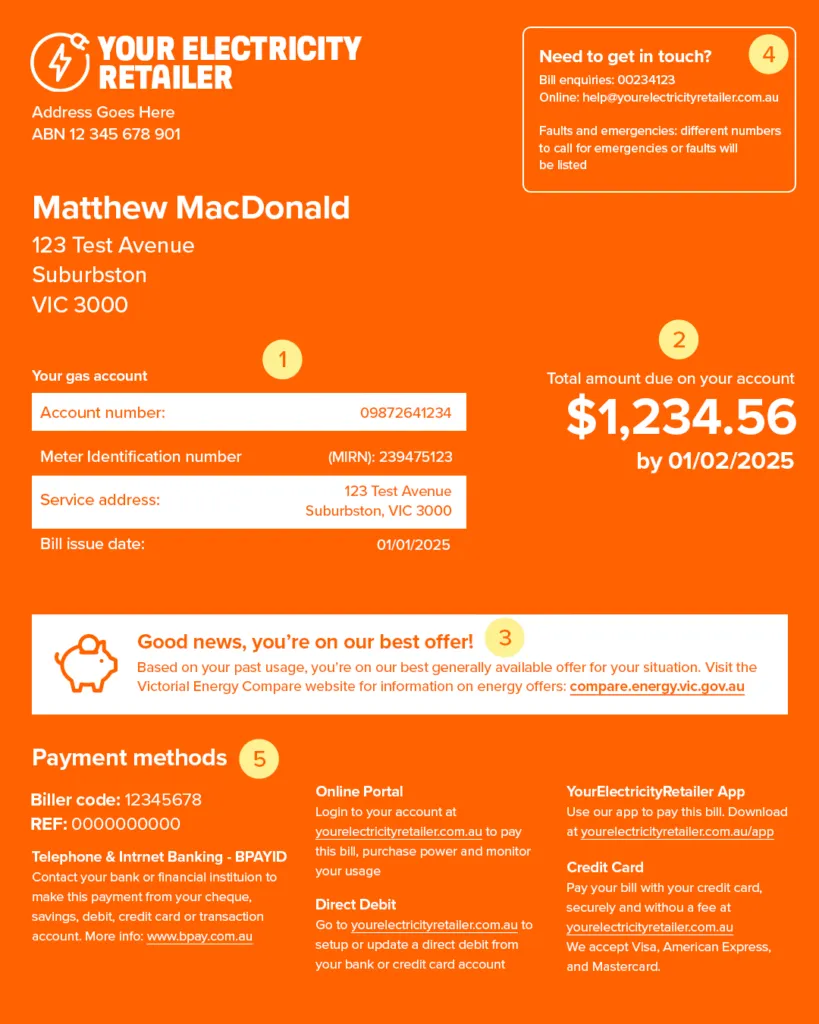
1 – Account details
This will include your invoice number, account number, name, address, and national metering identifier (NMI).
2 – Billing information
Here’s where you’ll find the total amount due and the date you need to pay it by.
3 – Best offer
This is a required section that lets you know whether you’re on the best plan from your provider. These usually pop up on your bill every four months and give you a quick little insight into how your current plan is working for you. If you’re not on the best offer, this section will tell you how you can switch over to it.
4 – Get in touch
Need to sort out a payment plan or report a fault? This section has all the contact details you need, including emergency numbers.
5 – Payment options
Here you’ll find all your payment options listed out, with details on how each method works. Most will include BPAY, online, direct debit, credit card, and app payments.
Page 2
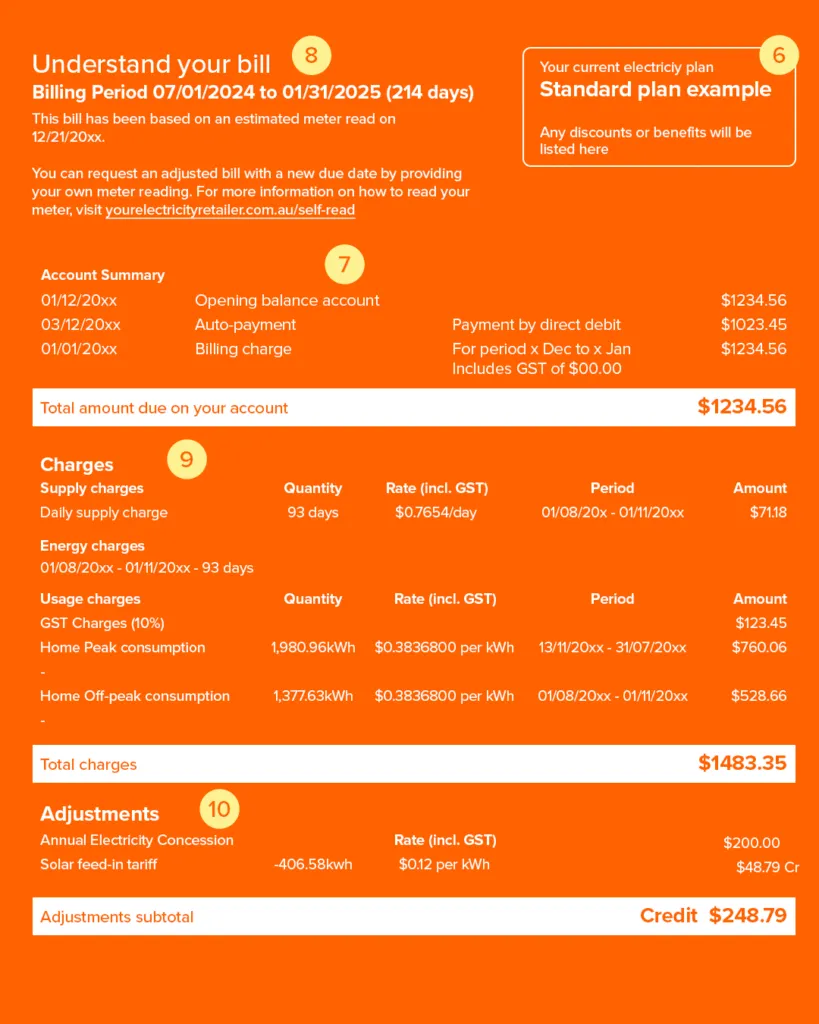
6 – Plan type
This shows the plan name with your current provider and any specific details about it.
7 – Account summary
This section lists out your opening balance over the previous billing period, any payments made, and the closing balance.
8 – Understanding your bill
This section outlines your billing period, along with any rates charged during certain times, like time-of-use tariffs (peak and off-peak) or controlled loads.
9 – Energy charges
This breaks down your usage and supply charges. Usage charges in this section will be split up depending on your tariff type. So, if you’re on time-of-use tariffs, you’ll see usage across different time periods. If you’re on a solar feed-in tariff, you’ll see your credits for any unused solar energy listed here.
10 – Adjustments
If you have any concessions, rebates or discounts, they’ll be listed here.
Page 3
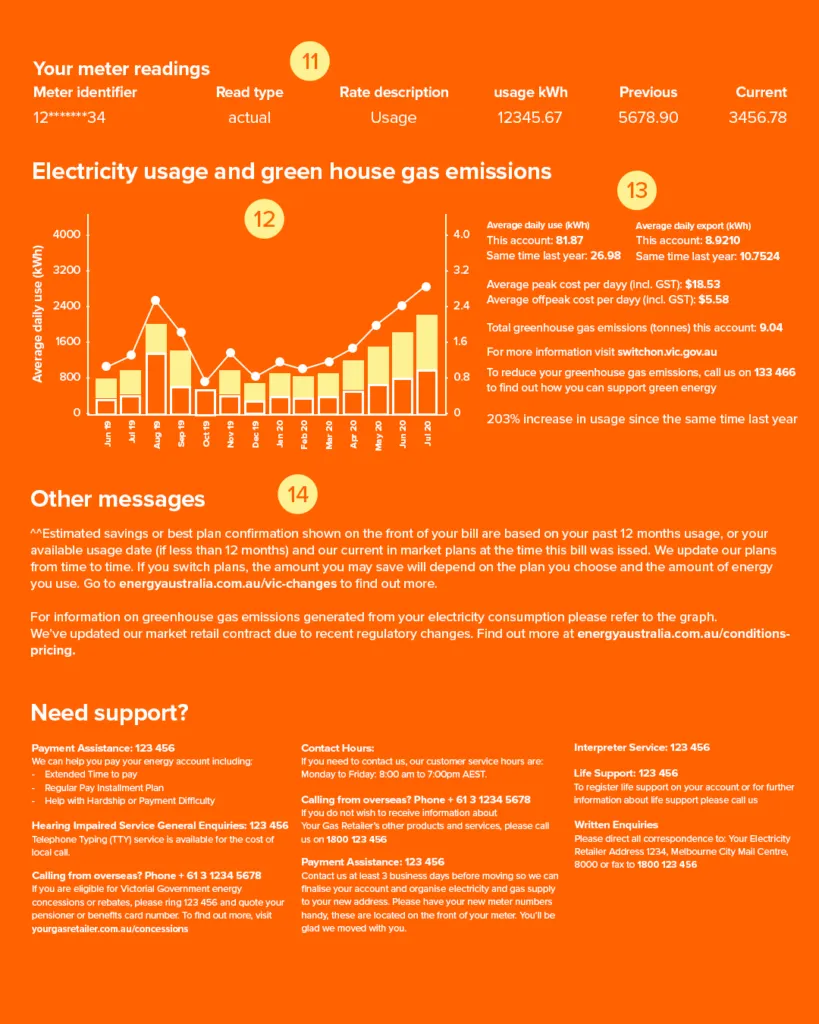
11 – Meter reading
In this section, you’ll find your meter information for the billing period. This will include your meter number, reading type (estimated or actual), usage readings (kWh), and your previous and current meter readings.
12 – Usage information
This section looks back at your energy usage and greenhouse gas emissions over several months. If you’ve got solar or time-of-use tariffs, this section will also break down your charges by how and when you use electricity.
13 – Average daily consumption
Attached to your usage information section will be a calculation of your average daily electricity consumption. This daily consumption figure will be compared to the same time last year and give you an average cost per day based off this figure.
14 – Other messages or help section
You’ll find contact information for payment assistance, the interpreter service, and concession information here. Some bills also cover important updates from your retailer, like reminders about energy rate changes.
 Helpful tip

If you’re comparing electricity market offers, you’ll often see plans with ‘X% less than the standard offer’ stamped across them. This isn’t just an advertising trick retailers use to make their plans look more appealing; it’s required information that has to be added so you can tell how much it differs from the benchmarks in your state. It’s a great shortcut to spot how one plan compares to another if you’re mainly focused on the price.
Julia Paszka
General Manager – Utilities
Ready to make sense of your power bill?
Feel like you’ve got the basics under wrap, but still want some help when it comes to comparing? At iSelect, we can help you compare from a range of plans and providers, taking all the little details into account. That way you can compare with confidence, instead of squinting at each charge line like it’s an ancient rune.
Get started on comparing energy plans today!
Save time and effort by comparing a range of energy plans with iSelect





iSelect does not compare all energy providers or plans in the market. The availability of plans may change from time to time, depending on who iSelect’s providers are and what plans they make available to iSelect. Not all plans made available from iSelect providers may be compared by iSelect either due to commercial arrangements, area or availability, so not all plans or providers compared by iSelect will be available to all customers. Some plans and special offers are available only from iSelect’s contact centre or website. Energy plans are available only for properties located in eligible areas of Victoria, New South Wales, South East Queensland, South Australia and ACT. Click here to view iSelect’s range of providers.