
.svg)

How Much Does It Cost to Replace a Windscreen?
How Much Does It Cost to Replace a Windscreen?




Written by
Tina Sendin
Edited by
Laura Crowden
Reviewed by
Adrian BennettCompare car insurance policies the easy way
Save time and effort by comparing a range of car insurance quotes with iSelect



Long story short
Windscreen repairs can start from as little as $60
Fixing small chips or cracks can start at around $60, but bigger jobs can range from $300 to a few thousand bucks depending on the damage and your car model.
Replacing a high-tech windscreen can cost over $1,000
Replacing a high-tech windscreen with features like rain sensors or lane assist can easily cost over $1,000 plus calibration fees.
Different states have specific rules about cracked windscreens
From NSW to WA, driving with a cracked windscreen may fail roadworthy checks or even land you in trouble, depending on your local laws.
Severe damage means it’s time for a replacement
If the damage messes with your view or weakens the windscreen’s structure – like cracks over 30mm – repairs just won’t cut it. Time for a new windscreen!
Some car insurance policies can help cover windscreen costs
Some comprehensive car insurance policies include windscreen repairs (and a few of them even waive the excess for chips)! Windscreen replacement though might come as an optional extra.
Can I drive with a cracked windscreen?
It really depends on how bad the crack in your windscreen is, along with where you live. Each state and territory have their own take on cracked windscreens.
Here’s what it all looks like per state. (Note that this isn’t legal advice, so it’s worth checking with your local roads authority for the rules in your state or territory.)
VIC
In Victoria, it’s illegal to drive a car if the damage to your windscreen is so bad that you can’t clearly see the road. Plus, your car won’t pass a roadworthy if the windscreen has cracks or chips that could mess with your vision.
Specifically, windscreens can become an issue if they’re discoloured, badly scratched, fractured, or chipped within the area wiped by the wipers and they prevent the driver from having a clear view of the road.
Laminated windscreens become problematic if the cracks go deeper than one layer of glass, are over 16mm in diameter for bullseye cracks, or go beyond 150mm in length – all within the area swiped by the wipers.1Vicroads – Vehicle Standards Information 26
The good news is if you’ve got one or more ‘bullseye’ or star fractures of that size and it doesn’t block the driver’s vision, then you’re in the clear in VIC!
NSW
Your car has to be safe to drive and roadworthy to stay registered. Windscreens need to be solid, properly fitted and give you a clear view of the road.
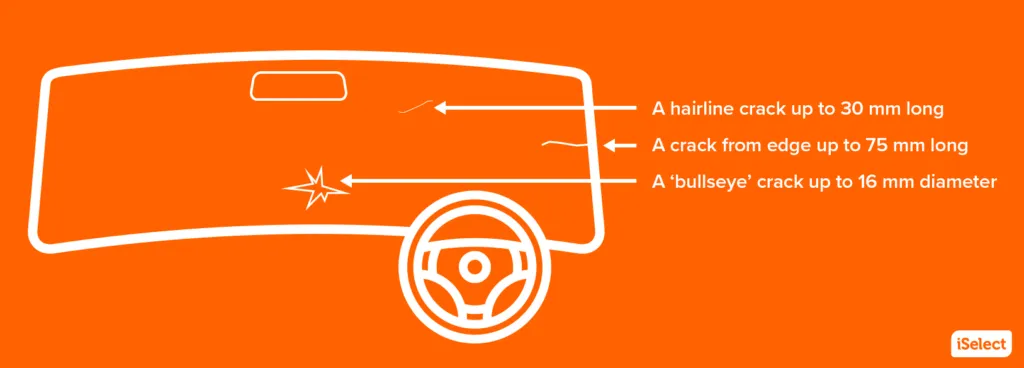
If your windscreen is seriously chipped, cracked, scratched, discoloured, or just can’t be properly repaired, Transport for NSW reckons it’s time to replace it. Now, the part of the windscreen right in front of the driver (up to the vehicle’s centreline) can only have two of the following defects:2Transport for NSW – Vehicle Standards Information
- a hairline crack up to 30 mm long
- a crack from edge up to 75 mm long
- a ‘bullseye’ crack up to 16 mm diameter
QLD
Queensland doesn’t mess around – cracked, chipped, or damaged windscreens are considered dangerous.
In fact, you’re not allowed to hit the road if the part of your windscreen that’s swept by the wiper blades (aka the primary vision area) is cracked, chipped, scored, badly sandblasted, or damaged in a way that messes with your vision or wrecks the wiper blades.3Queensland Transport – Vehicle Safety
SA
If you’re driving to the Adelaide Hills and noticed your windscreen is excessively cracked, chipped, or scratched, you should head back as your car is considered defective.4South Australian Government – Defective vehicles As to what ‘excessively’ technically means isn’t necessarily clear and can be interpreted in many ways.
WA, NT, ACT, TAS
Most jurisdictions follow the guidelines from the National Road Transport Commission’s Roadworthiness Guidelines, which is also the basis for NSW’s.
WA, NT, ACT and TAS are no different – they follow these rules too. Specifically, if the damage is right in front of the driver (up to the vehicle’s centreline), a car can still be roadworthy if it only has two of the following defects:5Transport for NSW – Vehicle Standards Information
- a hairline crack up to 30 mm long
- a crack from edge up to 75 mm long
- a ‘bullseye’ crack up to 16 mm diameter
Regardless of your location, the point is it’s worth fixing any windscreen damage sooner rather than later. Even a small crack in your windscreen can turn into a big one as the weather changes, and the glass expands and contracts.
Plus, given that the windscreen contributes to your vehicle’s structural strength and integrity, driving with a damaged windscreen can make your car a lot less safe.
So, getting it repaired early on can likely save you and your wallet down the track.
How much will windscreen repairs cost me?
Fixing a small crack or chip in your windscreen can start at around $60, but the cost really depends on your vehicle and how bad the damage is. More extensive repairs could set you back from $300 to a few thousand bucks.
But even a pricey repair usually costs less than replacing the windscreen. It can be worth a few thousand dollars to have a high-tech windscreen replaced and correctly calibrated to work with the car’s technology.
This hefty price tag may be a good reason to consider a car insurance policy that can help cover the costs of windscreen repairs or replacement.
There are a few things that’ll change how much you end up paying for a new windscreen. Here’s the lowdown:

Make and model of your car
The type of car you’ve got can make a big difference. Some cars have windscreens with special shapes, sizes, or swanky features like soundproof or laminated glass. Fancy or imported cars can mean a pricier repair job.

Vehicle year
Older, mass-produced cars can be easier to replace. But if we’re talking about old, classic models – that’s a different story. They might require some more TLC and customised fixing. Newer cars with all those high-tech extras, like built-in displays or rain sensors, could also mean a heftier bill as well.

Type of windscreen
Getting a replacement directly from the manufacturer can cost more because it’s designed specifically for your car and usually installed by the car maker, unlike aftermarket options. Some might also need to be recalibrated especially if the car has safety features like lane assistance or lane departure – adding more to the cost.

Repairer
Dealers might charge more than an independent repair shop, but you might like knowing your new windscreen is straight from the manufacturer. Plus, if your repairer is in the city, they tend to cost more than those in regional areas due to higher labour costs.
Size and position of the damage
Where the crack or chip is and how big it is can change the repair cost too. Damage in tricky spots, like right in your line of sight or near the edges, can mean you might have to spend your travel fund for a brand-new windscreen.
Can car insurance help me with windscreen replacement costs?
Yes! But it honestly depends on the level of cover you have, and the terms set down by your specific insurer.
Typically, comprehensive cover offers some kind of protection for windscreen damage. Some insurers include windscreen replacement as a standard inclusion on their comprehensive policies, but most offer windscreen cover as an optional extra.
With windscreen cover, your insurer will waive (or reduce) the excess if you make a claim for windscreen repairs. This is sometimes also referred to as reduced window glass excess, windscreen and window glass cover, or excess free windscreen cover.
But here’s the thing: even if your policy does include windscreen repairs, it might not always be worthwhile claiming minor windscreen repairs on your insurance – especially if you haven’t paid extra for windscreen cover.
This is because without windscreen cover, you will likely be charged a standard excess when you make a claim for windscreen repairs or replacement. This excess is an out-of-pocket expense you’re required to pay whenever you make a claim. And if the damage to your windscreen is minor, then your excess might cost more than simply paying the full repair cost yourself upfront.
Plus, without windscreen cover, claiming for windscreen repairs or replacements generally counts towards your claims history – at least with some insurers. That could mean higher premiums when it’s time to renew (and you can say goodbye to the no claims discount down the line, if your insurer has it.)
So whether you can – or should – use your car insurance for windscreen issues depends on how your particular policy works (and whether or not you’ve stumped up extra for windscreen cover).
This is why it’s always a good idea to read the product disclosure statement (PDS), which is usually available on the insurer’s website. This document will break down all the things you’re covered for, including all the limits and any exclusions that might apply.
 Helpful tip:

If you’ve got a clean record, it’s worth checking how a windscreen repair or replacement affects your no-claim bonus or claims history with your insurer. Some insurers won’t count it against you, so your record stays spotless. Others might include it in your claims history, potentially pushing your premiums up come renewal time. So it’s a good idea to double-check!
Adrian Bennett
General Manager for General Insurance
When do I need to replace my windscreen?
Let’s say there was a sudden downpour during your last drive and your car was pelted with hail. All it can take is one particularly hard chunk of ice shattered against your windscreen, and you’ve got a nasty crack in the glass.
After the initial shock wears off, you might be left wondering about the costs: Is this something that can be buffed out with a small repair, or is it going to need costly replacement?
Well, this will usually come down to a few factors:
Size of the damage
A small chip won’t usually be enough to weaken the structural integrity of the windscreen. A huge crack will. It can make the windscreen more fragile, and this means that a simple repair might not last for too long.
To some auto specialists’ eyes, it’s time to get a new one if any of the following happens:
- cracks longer than 30mm on the driver’s side
- a crack over 75mm that stretches to the windscreen’s edge on the driver’s side
- a bruise or star bigger than 16mm across
- any other damage that messes with the driver’s view.
Basically, if your windshield is causing you grief and making it hard to see the road clearly, it’s time to get it sorted!
Location of the damage
Damage at the edges of the windscreen can compromise its structural integrity, which may make a replacement necessary. If a crack is in your line of sight, repairing it can also leave distortions. In either case, full replacement might be your better option.
Depth of the damage
Most windscreens actually have multiple layers of glass. As you would expect, a crack or chip in the outer layer is usually easier to repair than damage that goes all the way through to the inner layers.
Of course, you’ll need to take each crack and chip on a case-by-case basis. There’s no substitute for getting a licensed professional to look at the damage. Ultimately, they’ll be the ones to tell you whether you’re looking at a 30-minute resin job or a total replacement.
Frequently asked questions
How is a windscreen replacement performed?
Here’s how the car experts usually replace windscreens:
- First, the windscreen repair folks cover the vehicle with industrial-strength padding for protection.
- They then remove any visible shattered glass from the vehicle’s interior and carefully take out the rear window seals using technologies like Ezi-wire while preparing the aperture.
- They clean and prepare the replacement glass, applying a precise bead of advanced urethane to its edges.
- Using a lifting tool, they fit the new rear window with precision to ensure a perfect fit.
- Finally, they thoroughly check and remove all visible glass pieces from the seats and floor, ensuring passenger comfort.
The whole process usually takes around 90 minutes, but it can be a bit longer if your windscreen has Advanced Driver Assistance Systems (ADAS) features and needs to be recalibrated.
What’s the difference between aftermarket and car manufacturer windscreens?
The main difference between aftermarket and car manufacturer windscreens boils down to who makes them.
If you’ve seen ‘OEM’ while looking for windscreen replacements, here’s what it means: original equipment manufacturer. They’re the same company that supplied the original windscreen when your car was built. Car manufacturer windscreens are designed to match the exact specs of your car – you’re getting the same fit, thickness, and features like rain sensors or heating elements.
These parts are your best bet if you want to keep your car’s original design and integrity spot on. But because of this, OEMs tend to be on the pricier side.
Aftermarket windscreens are made by third-party companies. They’re still designed to fit your car, but they might not have the exact same specs or features as the original. They’re usually cheaper, but sometimes the quality or fit can vary a bit.
Both can do the job – it just depends on your budget and how particular you are about keeping things original!
What are the types of windscreen damage?
There are different types of windscreen damage:
- Cracks: They’re longer and can spread over time if you get a bit slack with your mechanic visits.
- Bullseye: The name says it all. These are circular chips that look like a dartboard bullseye.
- Star: Again, this one’s pretty explanatory – they look like a little starburst with cracks shooting out from the centre.
- Crater: This damage happens when a cone-shaped chunk of glass gets taken out from the outer surface of a single layer of glass.
- Horseshoe: This looks like a half-circle that starts on the outer surface and gets wider as it works its way through to the inner surface of the glass.
- Edge cracks: They start near the edge of the windscreen and can be a real pain because they often mean a full replacement is needed.
- Combination: If you have the unlucky one-two punch of any of the above damages.
Looking to compare car insurance with optional extras?
iSelect makes it easy for you to compare car insurance policies, from our range of providers. Take a look today!
Get started on comparing car insurance policies!
Save time and effort by comparing a range of car insurance quotes with iSelect





iSelect General Pty Ltd (ABN 90 131 798 126. AFSL 334115) has partnered with Compare the Market (ABN 83 117 323 378. AFSL 422926) to compare a range of car insurers and policies. Not all providers in the market or all policies offered by the partners are compared and not all policies or special offers are available to all customers.
A number of our participating general insurance brands are arranged by Auto & General Services Pty Ltd ACN 003 617 909 on behalf of Auto & General Insurance Company Limited 111 586 353, both of which are related entities of iSelect Limited. Our relationship with those companies does not impact the integrity of our comparison service. Click here to view iSelect’s range of providers.
Any advice provided by iSelect is of a general nature and does not take into account your objectives, financial situation or needs. You need to consider the appropriateness of any information or general advice iSelect gives you, having regard to your personal situation, before acting on iSelect’s advice or purchasing any policy. You should consider iSelect’s Financial Services Guide which provides information about our services and your rights as a client of iSelect. iSelect receives commission for each policy sold that is a percentage of the premium or a flat fee. Ask us for more details before we provide you with any services.