
.svg)


What Is Net Metering?
What Is Net Metering?




Written by
Rachel Gregg
Edited by
Andrew Kemp
Reviewed by
Julia PaszkaCompare Electricity & Gas Plans
Save time and effort by comparing a range of energy plans with iSelect



Long story short
Net metering does more than just record your usage
It tracks both the power you pull from the grid and the solar you export, then it works out the final balance for your bill.
Homeowners get first dibs on their renewable energy
You use your own solar power before anything hits the grid, helping you self-consume and cut down on daytime energy costs.
Credits kick in behind the scenes
Any exported solar earns a feed-in tariff credit, which net metering automatically subtracts from any energy usage before you get your bill.
What is net metering?
A net meter is a type of smart meter that tracks electricity flows in and out of your house. It measures how much energy you pull from the grid, i.e. how much power you need once the sun is down, and how much excess power you send back to the electricity grid, which is where your feed-in tariff (FiT) might come into play.
Quick refresher: an FiT is the rate your electricity retailer pays for the solar power you export to the grid. That amount shows up on your electricity bill as a credit.
Net metering can sound a lot like gross metering, but the key difference here is how things land on your power bill. With solar net metering, self-consumption is the star of the show. Instead of separate totals for your energy use and exported surplus energy, it all happens quietly behind the meter, so all that’s shown on your power bill is the net result.
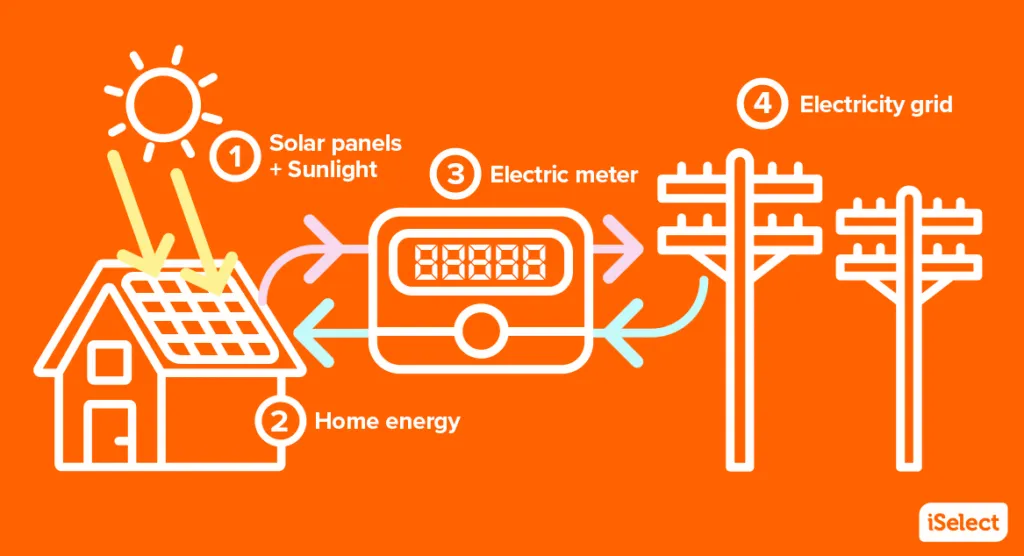
Think of it this way: with gross metering you sell every bit of solar you produce to the grid under at the FiT rate, and anything you consume is charged at your retailer’s rate. This system shows two items on your bill – your export sales and your purchase costs. But under net metering you consume as much of your own solar as you can, before exporting the excess in exchange for a FiT credit on your power bill. Your bill will then show what’s left to pay (if anything) before your billing cycle wraps up.
How does net metering work?

Your solar energy system powers your home first
When your panels collect sunshine, turning it into electricity with help from your solar inverter, you’ll always get first dibs (otherwise known as self-consumption). Daytime appliances, air cons, charges, they’ll all get powered up from your solar electricity.

The grid fills in any gaps
If your solar can’t match your energy consumption needs (whether that’s from a cloudy winter day or after sunset), your home will automatically pull some power from the main grid. This ensures your home runs smoothly.

Feed-in tariffs (FiTs) work behind the scenes
Any solar you’ve exported earns a FiT, but instead of appearing as a separate item on your bill, net metering automatically offsets it against your grid usage.

Net billing shows the final score
When your bill arrives, you should see one result:
- A credit – if your exported surplus of energy outweighs your grid use, or
- An amount to pay – if you used more grid power than you sent back.
Either way, the maths has already been done for you.
If your solar power system includes a solar battery, you could take your gains further by storing excess energy and deciding when to export it. This is known as time-of-use billing and can help you take advantage of higher FiT rates for your generated electricity during the evening peak.
 Helpful tip

To take advantage of net metering in Australia, your system will first need to be eligible for feed-in tariffs. This is only the case if an accredited solar installer instals your solar panels and connects them to the grid. Before locking anything in, double-check that your solar panel system meets the requirements (future you will thank you).
Julia Paszka
General Manager – Utilities & Credit Cards
Pros and cons of net metering

Pros
- Helps lower energy bills by offsetting nighttime electricity costs from the grid.
- Powers more than just your home, with EVs and work sheds included.
- Reduces your environmental footprint by being more self-sufficient.
- Can speed up the payback period on your solar system.

Cons
- You can’t go fully off-grid, as net metering needs a grid connection to work.
- You can still be affected by grid blackouts, such as during a load-shedding event.
- If you want to change providers but still have credit on your account, it might not be transferable.
Ready to get the most from your solar energy plan?
Net metering can be a simple way to squeeze more value out of your solar setup, and the energy plan you’re on could be the final piece to the puzzle. If you’re comparing energy plans or figuring out how solar can fit into your bills, iSelect can help line up your options so you can figure it out without the headache. Compare online from a range of plans and providers or call our energy comparison experts on 1800 664 532 for a helping hand.
Get started on comparing energy plans today!
Save time and effort by comparing a range of energy plans with iSelect





iSelect does not compare all energy providers or plans in the market. The availability of plans may change from time to time, depending on who iSelect’s providers are and what plans they make available to iSelect. Not all plans made available from iSelect providers may be compared by iSelect either due to commercial arrangements, area or availability, so not all plans or providers compared by iSelect will be available to all customers. Some plans and special offers are available only from iSelect’s contact centre or website. Energy plans are available only for properties located in eligible areas of Victoria, New South Wales, South East Queensland, South Australia and ACT. Click here to view iSelect’s range of providers.