
.svg)


Pedal power
How many cyclists are needed to power households and AI data centres?
Data centres are becoming some of the most important, and energy-hungry, pieces of infrastructure in modern life. They help power everything from online banking and streaming to the artificial intelligence tools millions of people now use every day.
This rapidly expanding industry is increasing the demand for electricity across the world, with a single hyperscale, AI-focused data centre having a capacity of 100 megawatts (MW) or as much annually as 100,000 households.1https://www.iea.org/reports/energy-and-ai/understanding-the-energy-ai-nexus In 2025, data centres around the world consumed 448 terawatt-hours (TWh) of electricity and are projected to double to 945 TWh by 2030.2https://www.reuters.com/business/energy/ai-double-data-centre-power-water-consumption-by-2030-un-researchers-say-2026-06-03/
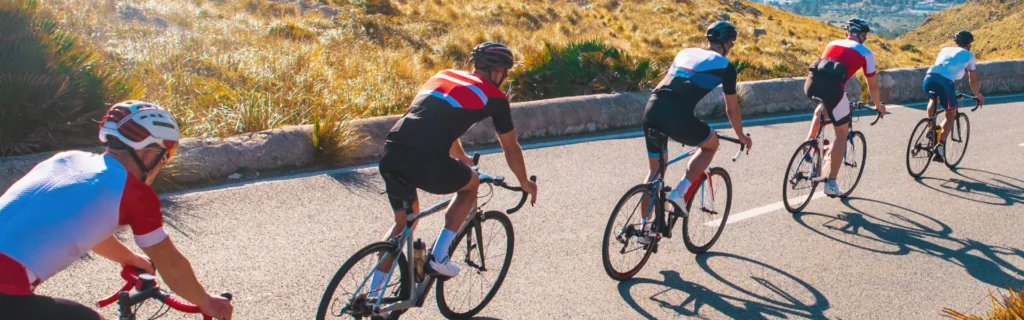
But the electricity needed to run them can be difficult to picture. So, inspired by the 2026 Tour de France, energy comparison service iSelect asked a simple question: how many cyclists would it take to pedal-power an AI data centre in comparison to the average Australian home?
Using estimated power outputs for beginner, amateur and professional cyclists, we calculated how many one-hour cycling efforts would be needed to power the average Australian household, as well as one large AI-focused data centre, and data centres across the world.
So, grab your Lycra and clip in to see how much pedal power it would take.
How many cyclists are needed to power the average Australian home?
To match the annual electricity use of an average Australian household (5,675,684Wh), it would take 38,143 beginner cyclists, 19,410 amateurs or 16,475 professionals riding for one hour. A month’s worth of power would require 3,179, 1,618, or 1,373 riders, narrowing to 105, 53, and 45 a day, or four, two, and two an hour.
Based on annual household energy consumption rates per state, the Northern Territory would need to recruit the most riders to power a single home, requiring 58,264 novices, 29,649 dedicated cyclists or 25,166 professionals to keep their lights on. Tasmania followed closely behind, needing 57,923, 29,476, or 25,019 cyclists per year.
The state that needed the least pedal power for a single home was Victoria, which requires an army of 31,458 beginners, 16,008 amateurs or 13,588 professionals. South Australia would require the second-fewest number of cyclists, with 33,266, 16,928, or 14,369. So, even the least energy-intensive states would require thousands of one-hour cycling efforts to match a household’s annual electricity use.
Across the states, between 2,600 and 4,900 beginners, 1,300 and 2,500 amateurs, or 1,100 and 2,100 professionals would be required to power a home for a month. For a day, it was between 86 and 160, 44 and 81, and 37 and 69, while for 60 minutes it ranged from 4-7, 2-3 and 2-3 riders to power a household. The hourly numbers equate to almost a Tour de France-sized team (usually 8 riders) of beginners and less than half a team of amateurs and professionals to generate the power needed.
How many cyclists would it take to power an AI data centre?
Billions of cyclists riding for one hour would be needed to generate enough electricity to keep a 100MW data centre running for a year (876 billion watt-hours required). As you can see, it’s quite a big jump from household power requirements.
Having beginners ride for an hour of effort at an output of 149 watt-hours (Wh) to generate the electricity needed, it would require around 5.8 billion riders for the year, 490 million a month, 16.12 million a day, and 672,043 every hour.
For rusted-on amateurs pumping out 292Wh, it would require almost 3 billion riders to keep a data centre running for a year, 250 million a month, 8.2 million a day and 341,986 an hour.
If you want to leave it up to professionals, such as current road world champion and four-time Tour de France winner Tadej Pogačar, you would need around 2.54 billion Pogačars for a year, 212 million a month, 7 million a day, and a team of 290,276 every hour. That’s a lot of Tadejs!
To put the daily figure into perspective, powering one data centre for a day would require the equivalent of about 3,652 Tour de France pelotons of beginner cyclists, 1,859 pelotons of dedicated amateurs or 1,578 pelotons of professionals, based on 184 riders starting the race.
That’s a lot of cyclists working hard and shows how quickly industrial-scale electricity demand dwarfs what humans can physically generate.
How many cyclists are needed to power all the world’s data centres?
To power all of the world’s data centres for the full year of 2025 would require 3.01 trillion beginners, 1.53 trillion committed cyclists and 1.30 trillion pros pedaling for 60 minutes each. In 2030, when the amount of power required for the world’s data centres would have doubled, the rider numbers would jump to 6.35 trillion, 3.23 trillion, and 2.74 trillion, which is a significant amount of human power!
For an hour’s work to power the world’s data centres in 2025 and 2030, it would require 343 million and 724 million beginners, 174 million and 368 million dedicated amateurs, or 148 million and 313 million professionals to keep those buildings firing.
How many cyclists are needed to power all the data centres in Australia?
Australia’s data centres, which used around 3.9 terawatt-hours (TWh) of electricity in 2025 and will need a total of about 12 TWh in 2030,3https://www.climatecouncil.org.au/what-does-the-data-centre-boom-mean-for-australias-switch-to-renewables/ would require 26.2 billion now and 80.6 billion beginners in the future, or 13.3 billion and 41 billion dedicated amateurs, or 11.3 billion and 34.8 billion clones of Australian 2011 Tour de France winner Cadel Evans in his prime to power them.
The 3.9 TWh and 12 TWh equate to 2% of electricity in the main grid in 2025 and 6% in 2030, respectively.3 To give you a better picture of how much power is required to keep these key pieces of infrastructure running, you would need almost 942 times the population of Australia in beginner cyclists at the end of 2025 and 2,900 times in 2030.
Breaking the pedal power down further to hourly, powering the country’s data centres for 60 minutes requires 2.99 million, 1.52 million, and 1.29 million riders in 2025. Fast forward to 2030, and those numbers skyrocket to 9.2 million, 4.68 million, and 3.97 million, which is more than the populations of five states and territories: Northern Territory, Australian Capital Territory, Tasmania, South Australia, and Western Australia.4https://www.abs.gov.au/statistics/people/population/national-state-and-territory-population/latest-release

“When you translate electricity demand into pedal power, the scale becomes hard to ignore,” she said.
“It would take hundreds of thousands of cyclists pedalling at any given moment throughout the year to match one hour of electricity demand from a large AI-focused data centre, and billions of cycling hours to match a full year of use.”
“Thankfully, Australians don’t need to recruit a backyard peloton to power their homes, but the numbers show just how much energy we rely on every day. As household electricity usage continues to rise, understanding where that power is going and whether you’re on a competitive plan is becoming more important than ever.
“It’s a timely reminder for households to review their own usage and compare energy plans to see if they could be getting a better deal.”
Julia Paszka
General Manager – Utilities at iSelect
Written by:

Sean Hardeman
Digital PR Advisor
 0424 107 600

Sean, a Digital PR Advisor with a career spanning more than seven years, is an experienced writer with a strong understanding of insurance and utilities.
He holds a bachelor’s degree in Journalism and a master’s in Marketing and Digital Communications, and has a knack for turning complex topics into interesting, easy to understand articles and explainers.
About the data
This dataset estimates how many cyclists would be needed to power a single hyperscale, AI-focused data centre, data centres around Australia and the world, and a single household for an hour, a day, a month and a year. We considered the total number of beginner, amateur and professional cyclists that are needed to power each category.
Results were calculated by dividing the electricity required for each scenario by the estimated electricity generated by one cyclist during a one-hour riding session. A cyclist’s one-hour energy output was estimated by multiplying their assumed power output in watts by one hour, producing a watt-hour equivalent.
Factors analysed were:
- Number of beginner cyclists needed to power a data centre and household.
- Number of dedicated amateur cyclists needed to power a data centre and household.
- Number of UCI WorldTour Professional cyclists needed to power a data centre and household.
- Number of beginner, amateur and UCI WorldTour Professional cyclists needed to power all data centres in the world in 2025 and 2030.
The assumed Functional Threshold Power (FTP) output for an hour cycling session was calculated as follows:
- Beginner at 2.4 W/kg for a 62kg cyclist = 149 Watts
- Dedicated amateur at 3.61 W/kg for an 81kg cyclist = 292 Watts
- UCI WorldTour professional at 5.3 W/kg for a 65kg cyclist = 345 Watts
All data is accurate as of 15/07/2026 and comes from multiple sources.
Sources:
- Brookings – Global energy demands within the AI regulatory landscape
- Cyclists Hub – What Is a Good Average Cycling Power? How Do You Compare?
- Domestique - Height and weight of pro cyclists
- Reddit - Dedicated cyclists, what’s your height and weight?
- Healthline – What’s the Average Weight for Males?
- Reuters – AI to double data centre power and water consumption by 2030, UN researchers say
- IEA – Understanding the energy-AI nexus
- Australian Energy Regulator – Residential energy consumption benchmark 2020
About 
At iSelect, we’re passionate about making Aussies’ lives easier by saving them time, effort and money. We are Australia’s go-to destination for comparison across insurance, utilities and personal finance products made available from our range of providers. Our service is provided at no cost to the customer.
iSelect does not compare all energy providers or plans in the market. The availability of plans may change from time to time, depending on who iSelect’s providers are and what plans they make available to iSelect. Not all plans made available from iSelect providers may be compared by iSelect either due to commercial arrangements, area or availability, so not all plans or providers compared by iSelect will be available to all customers. Some plans and special offers are available only from iSelect’s contact centre or website. Energy plans are available only for properties located in eligible areas of Victoria, New South Wales, South East Queensland, South Australia and ACT. Click here to view iSelect’s range of providers.