
.svg)

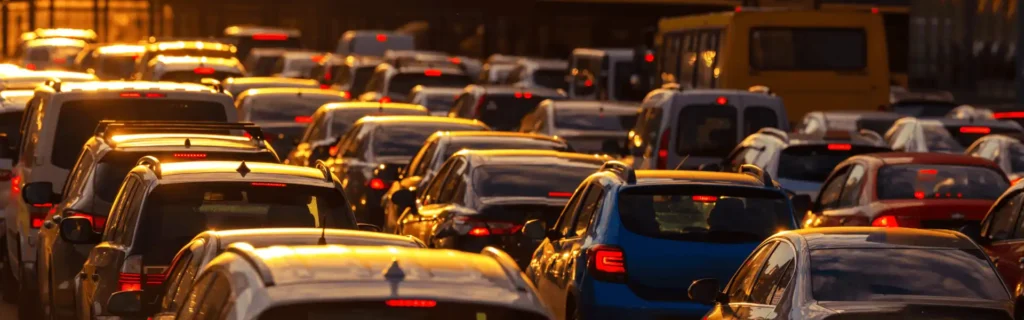
The World’s Busiest Highways
From the M4 Motorway to the Kwinana Freeway, Australia has its fair share of traffic hotspots in 2025. Here are the most congested roads in the world.
From sprawling cities to booming regional hubs, road congestion is a challenge faced in every corner of the globe. Economic growth, high population density and entrenched commuting habits all combine to create the world’s busiest highways, where delays can stretch for miles and travel times double during peak hours.
We all hate them, but we all need to use them.
In this report, car insurance comparison site iSelect analyses highway congestion statistics from major Australian and UK cities. By identifying the most congested roads, revealing key traffic hotspots in 2025 and highlighting typical daily vehicle counts, we aim to help drivers make informed decisions on when and where to travel.
Alongside the data, we’ll also provide expert guidance on navigating these busy routes safely and best ways to avoid them altogether during peak seasons.
The top 5 busiest Australian highways
Australia’s vast road network connects major cities, regional hubs and bustling ports. Certain routes consistently appear in highway congestion statistics for their heavy daily vehicle counts and frequent bottlenecks.
#1: M4 Motorway
Linking Sydney’s inner west to the Blue Mountains, the M4 Motorway is one of the most congested roads in New South Wales, and one of the busiest in all of Australia. Heavy commuter traffic and freight movement contribute to high daily vehicle counts, with peak-hour delays a regular occurrence.
- Number of lanes: 2 to 4
- Average peak daily traffic count: 300,000
- Negative sentiment: 75%
- Traffic and congestion mentions: 560
- Total score out of 100: 83.60
#2: M1 Pacific Motorway
Stretching from Sydney to Brisbane, the M1 Pacific Motorway is a critical freight and commuter route. It’s often named among the world’s busiest highways, with holiday periods turning certain stretches into major traffic hotspots in 2025.
- Number of lanes: 2 to 3
- Average peak daily traffic count: 250,000
- Negative sentiment: 2%
- Traffic and congestion mentions: 4,300
- Total score out of 100: 67.58
#3: Kwinana Freeway
The Kwinana Freeway connects Perth’s central business district (CBD) to its southern suburbs and beyond. This route regularly features in highway congestion statistics for Western Australia due to dense suburban growth and limited alternative corridors.
- Number of lanes: 2 to 5
- Average peak daily traffic count: 195,736
- Negative sentiment: 43%
- Traffic and congestion mentions: 4,180
- Total score out of 100: 54.96
#4: Tullamarine Freeway
Providing the main link between Melbourne Airport and the CBD, the Tullamarine Freeway experiences consistently high daily vehicle counts. Congestion intensifies during peak commuting hours and major events at Melbourne’s sporting precincts.
- Number of lanes: 3 to 5
- Average peak daily traffic count: 210,000
- Negative sentiment: 5%
- Traffic and congestion mentions: 480
- Total score out of 100: 50.83
#5: Bruce Highway
Running from Brisbane to Cairns, the Bruce Highway is Queensland’s major north–south arterial. It’s a vital freight route but also one of the most notorious traffic hotspots in 2025 during school holidays and cyclone season, when both tourism and weather can disrupt travel.
- Number of lanes: 1 to 4
- Average peak daily traffic count: 167,648
- Negative sentiment: 18%
- Traffic and congestion mentions: 5,300
- Total score out of 100: 48.95
Top 5 busiest UK highways
From London’s orbital motorway to key intercity links, the UK’s most congested roads are vital to the economy yet notorious for delays, making them prominent traffic hotspots in 2025.
#1: M25: 16-15 segment
Encircling London, this stretch of the M25 in Buckinghamshire is one of the most congested roads in the UK. High daily vehicle counts come from a mix of commuter, freight and long-distance traffic, making it a notorious traffic hotspot during peak hours.
- Number of lanes in segment: 4
- Average peak daily traffic count: 205,344
- Negative sentiment: 22%
- Traffic and congestion mentions: 71,620
- Total score out of 100: 91.16
#2: M25: 14 Hillingdon Boundary
Serving as a key western approach to London, this part of the M25 consistently ranks high in highway congestion statistics. Its proximity to Heathrow Airport further adds to delays, especially during holiday periods.
- Number of lanes in segment: 6
- Average peak daily traffic count: 210,436
- Negative sentiment: 22%
- Traffic and congestion mentions: 71,620
- Total score out of 100: 90.00
#3: M25: 13-14 segment
Known for bottlenecks and frequent slowdowns, this segment of the M25 suffers from both local and through traffic. It’s a prime example of how world’s busiest highways status can apply even to short stretches of road in Surrey.
- Number of lanes in segment: 5
- Average peak daily traffic count: 205,995
- Negative sentiment: 22%
- Traffic and congestion mentions: 71,620
- Total score out of 100: 88.53
#4: M60: 13-12 segment
Part of Manchester and Salford’s orbital motorway, this section of the M60 handles dense commuter flows and freight traffic. It’s a regular traffic hotspot for the northwest, particularly during weekday mornings and evenings.
- Number of lanes in segment: 4
- Average peak daily traffic count: 192,025
- Negative sentiment: 15%
- Traffic and congestion mentions: 18,320
- Total score out of 100: 64.35
#5: M6: 20-21 segment
As a key link between the northwest and the Midlands, this Warrington stretch of the M6 sees some of the highest daily vehicle counts in the region. Congestion here is common, with delays worsened by accidents and roadworks.
- Number of lanes in segment: 3
- Average peak daily traffic count: 178,281
- Negative sentiment: 13%
- Traffic and congestion mentions: 48,860
- Total score out of 100: 55.90
What causes highway congestion?
Several factors combine to create the conditions seen on the world’s busiest highways. Urban sprawl pushes residential areas further from city centres, increasing reliance on cars for commuting. Heavy freight movement, particularly on routes linking ports and industrial hubs, raises daily vehicle counts and slows traffic flow. 1Mingshu Wang, Neil Debbage, “Urban morphology and traffic congestion: Longitudinal evidence from US cities”. Computers, Environment and Urban Systems, Volume 89, 2021, 101676, ISSN 0198-9715.1.
Economic hubs naturally attract high numbers of workers, shoppers and visitors, but inadequate public transport can leave few alternatives to driving. Together, these pressures create persistent highway congestion statistics and turn key routes into year-round traffic hotspots.
Why this matters to drivers
Understanding which routes rank among the most congested roads isn’t just about avoiding frustration, as it also has financial and environmental implications. Stop-start driving in traffic hotspots increases fuel consumption, raising costs for motorists. Prolonged congestion also accelerates wear-and-tear on key vehicle components such as brakes, clutches and gearboxes, adding to the cost.
On a broader scale, idling vehicles contribute significantly to emissions, adding to the environmental impact of highway congestion statistics.
It also exposes you to an increased risk from a higher volume of other road users.

“It’s important to do your research and consider your car insurance options. By comparing car insurance you can check to see if there’s a more affordable policy available. If you’re going to be stuck in awful traffic because you need the highway in peak hour, you might as well reduce the impact it will have on your wallet.”
Adrian Bennett
General Manager – General Insurance
Written by:

Sarah Grealy
Digital Public Relations Specialist
 0413 363 690

Sarah is our Digital Public Relations Specialist, and brings more than a decade of experience in the insurance comparison industry to iSelect.
With a passion for storytelling through data-driven insights, Sarah strives to empower Aussies with practical guides and tips.
About the data
This dataset ranks 25 motorway segments in the UK, and 33 highways/major roads in Australia, based on how congested they can be. To do this, 4 different factors were used. Once the data for the factors was collected, the factors were then normalised, to provide each factor with a score between 0 and 1. If data was not available, a score of 0 was given. The normalised values were then summed & weighted, to give each motorway segment/highway a total score out of 100. The motorway segments/highways were then ranked from highest to lowest, based on their total scores.
The factors used are as follows:
• Avg Daily Motor Vehicles (UK) – The average daily motor vehicle count in 2024 on each highway segment (Each motorway is limited to a maximum of 3 segments).
• Avg Peak Daily Traffic Count (AUS) – The average peak daily traffic count along each highway in the most recent year available.*
• No of Lanes (UK) – The number of lanes on the specific motorway segment.
• No of Lanes (AUS) – The number of lanes featured along the whole motorway. Index score is calculated using the midpoint of the number of lanes.
• Negative Sentiment – The percentage of posts on Brandwatch, that mention “X” and have a negative sentiment, where X is the motorway/highway name, in the last year.
• Traffic & Congestion Mentions – The total number of mentions on Brandwatch, for the prompts: “X traffic” & “X congestion”, where X is the motorway/highway name, in the last year.
• The factors were indexed as follows:
• Avg Daily Motor Vehicles/Avg Peak Daily Traffic Count – Higher is better.
• No of Lanes – Lower is better.
• Negative Sentiment – Higher is better.
• Traffic & Congestion Mentions – Higher is better.
• The factors were weighted as follows:
• Avg Daily Motor Vehicles/Avg Peak Daily Traffic Count – 70%
• No of Lanes – 10%
• Negative Sentiment – 10%
• Traffic & Congestion Mentions – 10%
All data is correct as of 24/07/25. The ranking data shown is a compilation of multiple data sources and may not be representative of real life. All data is accurate with regards to the sources provided.
A motorway segment is a small part of a larger motorway, i.e. a segment between 2 motorway junctions, and each route is limited to a maximum of 3.
*Note – Traffic count data for the following motorways/freeways are based on estimates rather than exact values due to limited data: M1 Pacific, M4, M5, West Gate, Monash, Eastern, M80 Ring Road & Tullamarine.
Sources:
Avg peak daily traffic count (Majority of Aus Highways):
NSW – https://maps.transport.nsw.gov.au/egeomaps/traffic-volumes/index.html
TAS – https://tasmaniatrafficdata.drakewell.com/publicmultinodemap.asp
SA – https://data.sa.gov.au/data/dataset/top-40-trafficked-road-sections-in-sa
WA – https://trafficmap.mainroads.wa.gov.au/map
QLD – https://www.data.qld.gov.au/dataset/traffic-census-for-the-queensland-state-declared-road-network/resource/b856deab-ab20-48f1-85c6-2715e3a1d42c
Average peak daily traffic count:
M1 Pacific Motorway – https://www.transport.nsw.gov.au/news-and-events/media-releases/major-milestone-for-warringah-freeway-as-new-southbound-on-ramp
West Gate Freeway – https://bigbuild.vic.gov.au/projects/west-gate-tunnel-project/about/traffic-and-freight-on-the-west-gate-freeway
M4 Motorway – https://www.transport.nsw.gov.au/projects/strategy/transport-technology-strategy/delivering-transport-outcomes-technology/transport-1
M5 Motorway – https://www.ventia.com/what-we-do/projects/m5-east
Monash Freeway – https://en.wikipedia.org/wiki/Monash_Freeway
Eastern Freeway – https://bigbuild.vic.gov.au/library/north-east-link/fact-sheets/project-overview/project-design-update-burke-road-to-tram-road-september-2024
M80 Ring Road – https://engage.vic.gov.au/m80-upgrade
Tullamarine Freeway – https://www.premier.vic.gov.au/new-lane-to-open-on-the-tullamarine-freeway-0
No of lanes in segment (UK):
https://www.roads.org.uk/
No of lanes (Aus):
https://www.google.com/maps
Negative Sentiment + Traffic and Congestion Mentions:
https://www.brandwatch.com/
Populations (UK):
https://www.statista.com/statistics/294729/uk-population-by-region/
Populations (Aus):
https://www.abs.gov.au/statistics/people/population/national-state-and-territory-population/latest-release
iSelect does not compare all car insurance providers or policies in the market. The availability of policies will change from time to time. Not all policies available from its providers are compared by iSelect and due to commercial arrangements, your stated needs and circumstances, not all policies compared by iSelect are available to all customers. Some policies and special offers are available only from iSelect’s contact centre or website. Click here to view iSelect’s range of providers.
About 
At iSelect, we’re passionate about making Aussies’ lives easier by saving them time, effort and money. We are Australia’s go-to destination for comparison across insurance, utilities and personal finance products made available from our range of providers. Our service is provided at no cost to the customer.
iSelect General Pty Ltd (ABN 90 131 798 126. AFSL 334115) has partnered with Compare the Market (ABN 83 117 323 378. AFSL 422926) to compare a range of car insurers and policies. Not all providers in the market or all policies offered by the partners are compared and not all policies or special offers are available to all customers.
A number of our participating general insurance brands are arranged by Auto & General Services Pty Ltd ACN 003 617 909 on behalf of Auto & General Insurance Company Limited 111 586 353, both of which are related entities of iSelect Limited. Our relationship with those companies does not impact the integrity of our comparison service. Click here to view iSelect’s range of providers.
Any advice provided by iSelect is of a general nature and does not take into account your objectives, financial situation or needs. You need to consider the appropriateness of any information or general advice iSelect gives you, having regard to your personal situation, before acting on iSelect’s advice or purchasing any policy. You should consider iSelect’s Financial Services Guide which provides information about our services and your rights as a client of iSelect. iSelect receives commission for each policy sold that is a percentage of the premium or a flat fee. Ask us for more details before we provide you with any services.